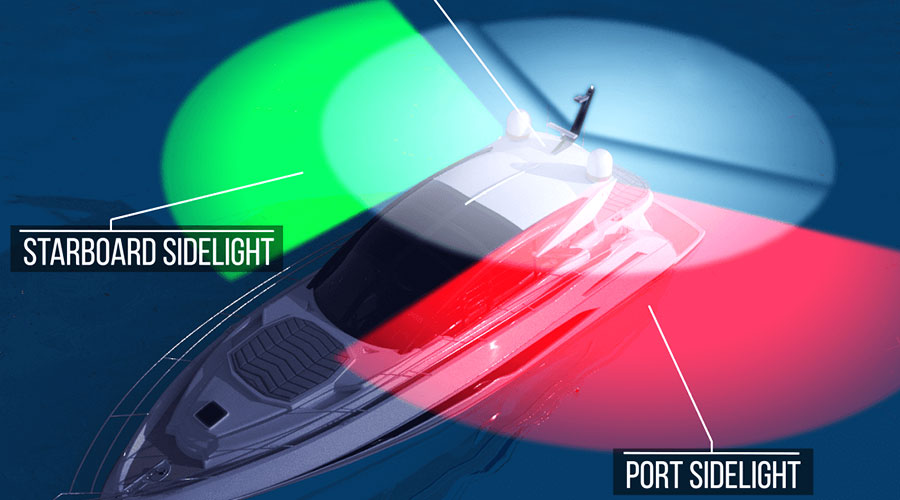
On the pitch-black sea, ships rely entirely on a universal visual language to cross paths safely and avoid collisions—port and starboard sidelights, also known as navigation lights. For any vessel light navigating at night or in low visibility, properly configuring and installing port light and starboard light units is not only a strict maritime regulatory requirement, but also the first line of defense to safeguard crew lives. However, when selecting or replacing boat navigation light setups, many novice boat owners mistakenly believe that “as long as it’s bright enough and shines, it’s fine.” In fact, selecting and installing marine lights involves quite a few technical details that are easy to stumble on.
I. What Are Port and Starboard Sidelights?
Under maritime navigation rules, port light and starboard light fixtures are collectively referred to as sidelights. They serve as a vessel’s “turn signals” and “ID cards” at night:
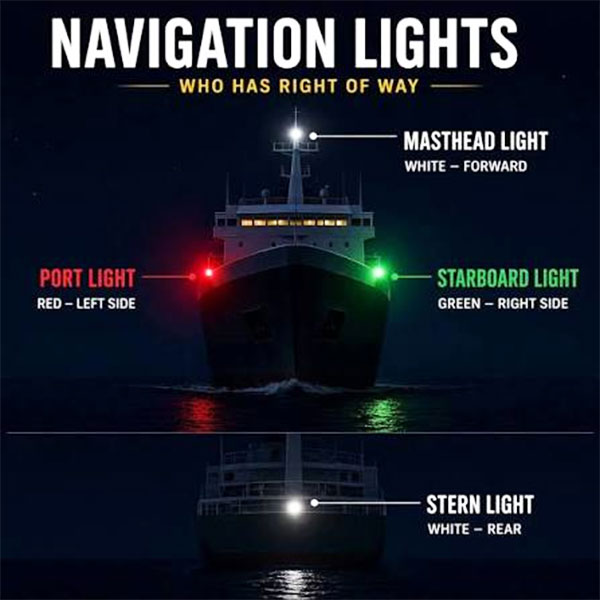
- Red Port Light: Displays a steady red light, installed on the port (left) side of the vessel.
- Green Starboard Light: Displays a steady green light, installed on the starboard (right) side of the vessel.
Light Angle Coverage
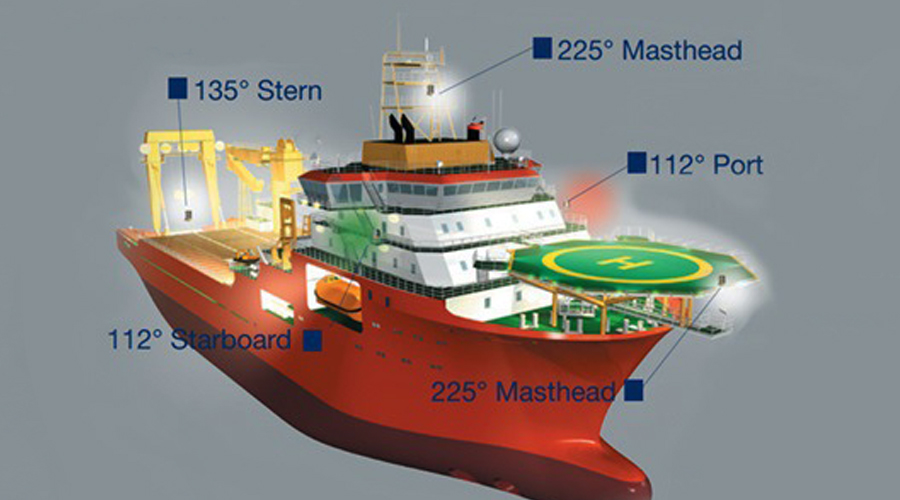
- Each sidelight covers a horizontal arc of 112.5 degrees (extending from directly ahead to 22.5 degrees abaft the beam on its respective side).
- Combined, these two navigation lights cover a 225-degree arc directly ahead of the vessel.
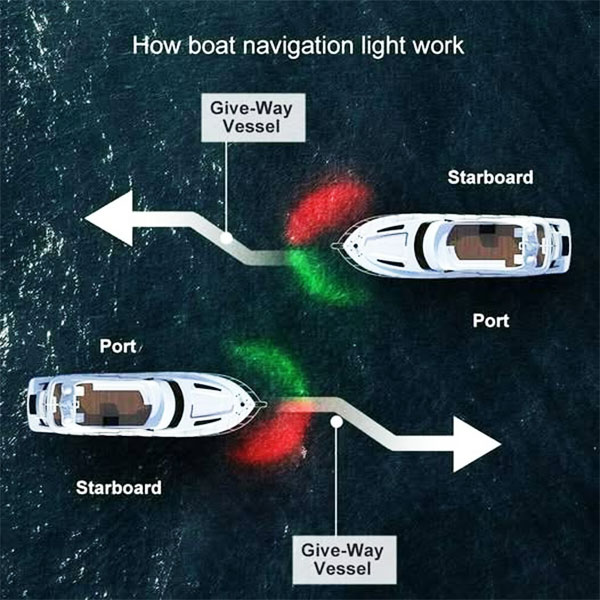
The memory mnemonic is simple: “Red on Left, Green on Right.” In night navigation, when an observer sees a red port light ahead, it means the other vessel is presenting its port side (in a crossing situation, this usually means they have the right-of-way, and you must yield); if you see a green starboard light, it means the vessel is passing on your right.

II. How to Choose the Right Sidelights for Your Vessel?
When selecting a boat navigation light or vessel light, do not blindly pursue aesthetics or extreme brightness. The core choice for sidelights depends on Length Overall (LOA) and application scenarios:
- Determine Visibility Range:
- LOA under 12 meters: Minimum required visibility range for port and starboard sidelights is typically 1 nautical mile (NM).
- LOA 12 meters to 50 meters: Sidelights visibility range must reach 2 nautical miles (NM).
- LOA over 50 meters: Typically required to reach 3 nautical miles (NM).
- Certification Markings: Ensure purchased navigation lights comply with relevant regulations of the International Maritime Organization’s Convention on the International Regulations for Preventing Collisions at Sea, 1972 (COLREGs), and carry compliance markings such as USCG (US Coast Guard Approved), CE, or Wheelmark (EU Marine Equipment Directive).
III. 4 Key Details for Selecting and Installing Port and Starboard Sidelights
After understanding the basic rules, here are four easily overlooked yet vital details during procurement and installation:
1. Beam Angle Control: Why Must the Cutoff Angle Be Strictly Limited to 112.5°?
According to COLREGs, the horizontal cutoff angle of port and starboard sidelights must be precisely controlled at 112.5 degrees (extending from dead ahead to 22.5 degrees abaft the beam).
- What if it exceeds by 1 degree? If the angle is too wide (e.g., light leaks toward the stern), an overtaking vessel behind you might misinterpret your position as crossing and make an incorrect evasive maneuver.
- What if it falls short by 1 degree? If the angle is insufficient, at certain encounter angles, the other vessel will lose visual perception of you entirely, creating a dangerous blind spot.
- Practical Advice: Always use the alignment guide lines on the light fixture during installation to ensure the light’s centerline is perfectly parallel to the vessel’s keel line (fore-and-aft baseline).
2. Salt Spray and Waterproofing: IP67 or IP68?
Marine environments involve high salinity, high humidity, and powerful wave impacts, posing a major test for light housings and internal circuitry. Sidelights are mounted at the bow or along the sides, directly exposed to waves and storms. Protection ratings should be at least IP67 (protected against temporary immersion); for positions frequently hit directly by waves, IP68 (fully waterproof encapsulated) is recommended. For materials, prioritize 316 stainless steel housings or UV-resistant corrosion-proof polymers. Wiring terminals must be sealed with heat-shrink tubing to prevent seawater from wicking along cables and causing internal corrosion or short circuits.
3. Light Source Upgrade: How to Avoid “Color Distortion” When Replacing Halogen with LED?
More and more vessel owners are upgrading traditional halogen bulbs to LED sidelights for energy efficiency and long service life. But there is a major trap: you cannot simply insert a white LED into a colored lens.
- Spectrum Matching Issue: The light from white LEDs is primarily produced by blue chips exciting yellow phosphors, making its red wavelength band very weak. If you put a white LED inside a red port light housing, red light transmittance drops sharply, drastically reducing visibility distance or making the light appear yellowish/pinkish.
- Correct Practice: When replacing LEDs, you must use dedicated red LEDs (for port light units) and green LEDs (for starboard light units), or directly purchase integrated, sealed professional LED sidelights assemblies.
4. Screening & Internal Light Leak Prevention
Port and starboard sidelights are not only for others to see—they must also avoid interfering with the captain’s own night vision. During installation, the inner side of the boat navigation light fixture must be equipped with a matte black screen (Screening) to prevent light from scattering toward the vessel’s interior. If reflected light shines onto the foredeck or wheelhouse glass, it causes glare for the operator at night, severely ruining night adaptation and rendering them unable to see hazards on the water surface.
IV. FAQ
Q1: Are Small Rowboats, Inflatable Dinghies, or Kayaks Also Required to Install Port and Starboard Sidelights?
- Answer: According to COLREGs, rowboats or small unpowered vessels under 7 meters in length that cannot be fitted with fixed port light and starboard light fixtures must at least carry a flashlight or an available white light at night to display in time to prevent a collision. However, for powered vessels of any size, configuring compliant port and starboard sidelights for night navigation is recommended.
Q2: Can Port Lights and Starboard Lights Be Combined and Installed in the Same Housing?
- Answer: Yes, but this is usually limited to vessels under 12 meters in length. This combination fixture is called a “Combined Sidelights” (or bi-color light) and is typically mounted on the bow centerline. For vessels over 12 meters, port light and starboard light units must be installed independently on respective sides of the hull.
Q3: Do LED Sidelights Need Frequent Replacement? What Are Their Advantages?
- Answer: Compliant LED vessel light fixtures typically feature a service life of over 50,000 hours and are virtually maintenance-free. Compared to traditional halogen bulbs, LEDs consume only 10% to 20% of the power, significantly easing nighttime power demands for battery-dependent small yachts or sailboats using LED sidelights.