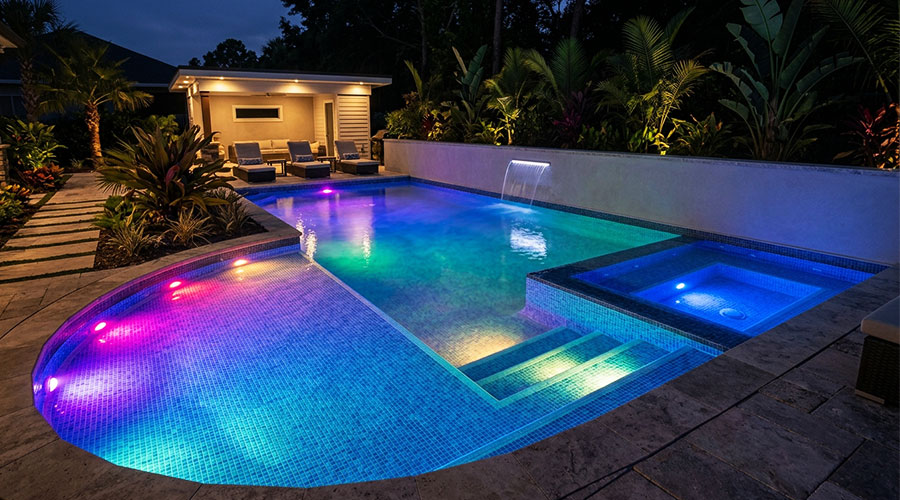
Underwater lights are not only vital accessories for private swimming pools, commercial water parks, and hotel resorts, but also crucial installations to ensure nighttime swimming safety and create a luxury aquatic ambiance. High-quality pool lights can transform a dark body of water into a visually stunning piece of art.
However, due to the unique underwater environment—which presents risks of electrical hazards, water pressure impact, and chemical corrosion—choosing the right swimming pool LED underwater lights is not merely about aesthetics. It is a professional engineering decision involving electrical safety, optical performance, and structural protection.
I. Key Functions and Importance of Swimming Pool Underwater Lights
- Nighttime Swimming Safety Assurance: Providing sufficient illumination for pool bottoms and walls eliminates underwater blind spots, helping swimmers gauge depth and distance accurately to prevent collisions and accidents.
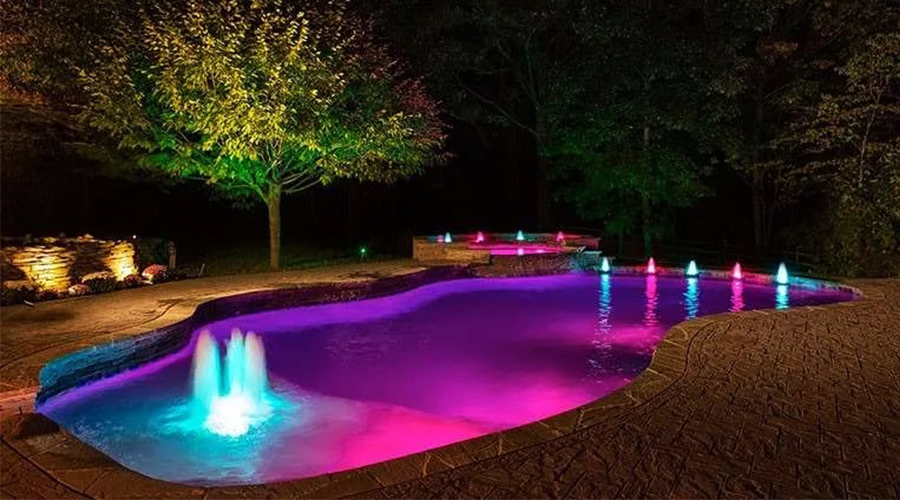
- Visual Aesthetics and Atmosphere Creation: Through precise color temperatures (such as crisp cool white or warm white) and dynamic RGB color-changing effects, pool lighting enhances water clarity and elevates the landscape’s aesthetic appeal.
- Extended Pool Operating Hours: Proper LED pool lights seamlessly extend the pool’s usability from day to night, maximizing the functional and commercial value of residential and commercial properties.
II. Traditional Pool Lights vs. Modern Swimming Pool LED Underwater Lights
In the early days of pool construction, halogen and incandescent bulbs dominated the market. However, with advances in optoelectronics, LED pool lights have fully replaced traditional illumination products to become the industry standard.
| Comparison Feature | Traditional Pool Lights (Halogen / Incandescent) | Modern Swimming Pool Underwater Lights |
| Energy & Efficiency | High consumption (300W–500W), low luminous efficiency | Ultra-low power consumption (12W–50W), saving over 80% energy |
| Lifespan | Short lifespan (~1,000 – 2,000 hours), frequent replacements | Long operational life (30,000 – 50,000+ hours), low maintenance |
| Heat & Safety | Extremely high heat output, compromising seals | Low heat generation, operating on safe low voltage (SELV) |
| Color & Control | Single warm tone; requires manual color filters | Rich spectrum (Single / RGB / RGBW), supports Remote & DMX controls |
| Structure & Durability | Bulky design, deep niches prone to dirt accumulation | Compact, surface-mounted or recessed designs with superior corrosion resistance |
III. Key Factors When Choosing Swimming Pool Underwater Lights
When selecting or replacing underwater pool lights, evaluate the following technical standards:
1. Safety Certifications and Ingress Protection (IP Rating)
- Waterproof Rating: Must reach the highest IP68 protection rating to withstand long-term water pressure without leakage.
- Safety Voltage: Must operate on Safety Extra-Low Voltage (SELV), typically 12V or 24V (AC/DC). High voltages (such as 110V/220V) are strictly prohibited for direct underwater connections.
2. Housing Materials and Anti-Corrosion Performance
Pool water contains chlorine disinfectants, salt content (in saltwater pools), and pH balancers:
- 316L Stainless Steel: Ideal for high-salinity and highly corrosive environments, such as saltwater pools or coastal installations.
- 304 Stainless Steel / High-Grade PC & ABS: Suitable for standard fresh water pools, offering high UV resistance and cost-efficiency.
3. Installation Types and Structure
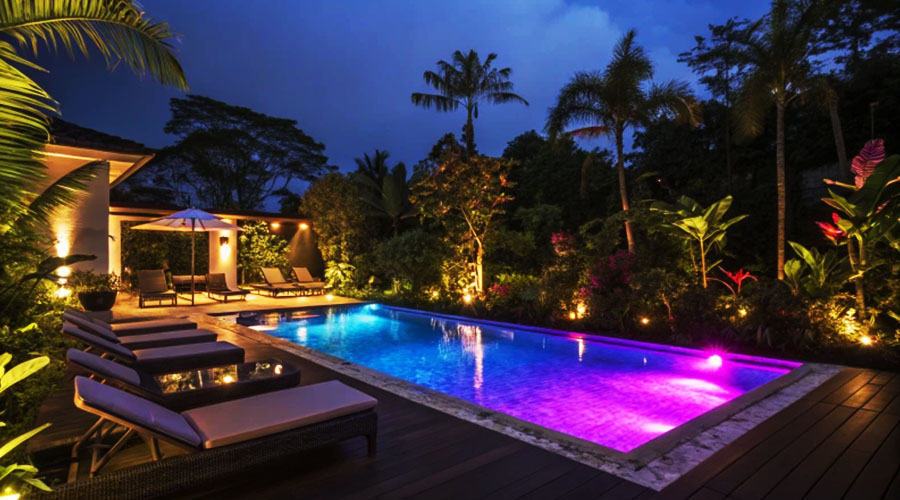
- Wall-Mounted (Surface-Mounted Pool Lamps): Requires no deep niche prep; directly fixed to the pool wall, making it ideal for pool renovations or quick installations.
- Recessed / Embedded Pool Lamps: Requires a pre-buried niche built into the wall. The light face sits flush with the wall, delivering a sleek appearance.
4. Optics, Color Temperature, and Power Calculation
- Color Temperature: 6000K–6500K Cool White creates crystal-clear water; 3000K Warm White provides a cozy resort vibe; RGB/RGBW is ideal for parties and commercial venues.
- Power Output: A general guideline for residential pools is 15–20W LED power per 10m². Adjust based on pool depth and wall color.
💡 Selection Tip: Adjust Light Intensity Based on Pool Finish Color
Light blue or white mosaic finishes reflect more light, requiring lower wattage. For dark blue, black, or industrial concrete finishes that absorb light, increase fixture count or wattage by 30%–50%.
IV. Typical Application and Product Recommendations
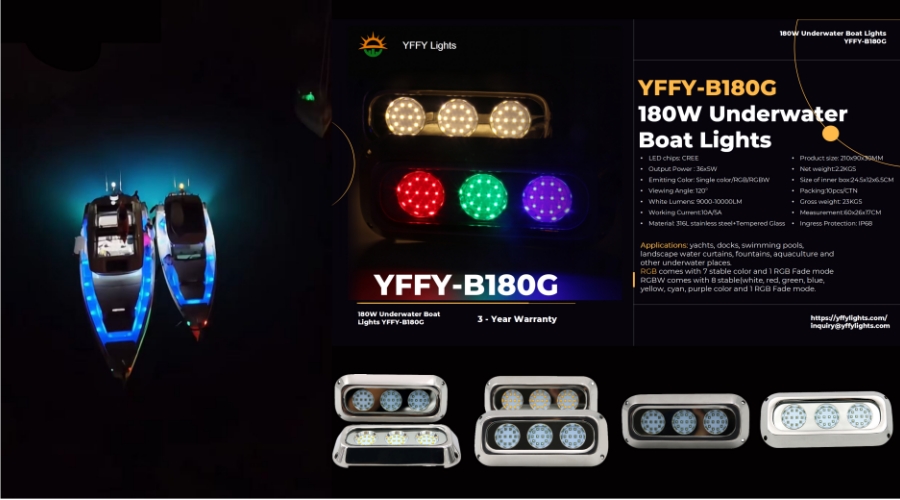
Based on common pool types and real-world application needs, here are typical examples of underwater LED lights (such as those offered in the YFFY Lights) to guide your selection:

1. Ultra-Thin Wall-Mounted LED Pool Light
- Technical Features: Ultra-slim profile design fixed directly onto the pool wall without needing deep niches. Features high-impact PC/ABS casing or stainless steel trim with IP68 structural sealing.
- Best Suitable For: Pool renovations, vinyl liner pools, and fiberglass pools.
- Selection Analysis: Retrofitting existing pools or non-concrete pools often prevents digging large niches. These surface-mounted underwater lights install effortlessly, minimize wall projection, and keep swimming space clear.
2. Recessed LED Pool Light with Niche
- Technical Features: Combines a 304/316L stainless steel face ring with a heavy-duty plastic pre-buried niche. The light face sits completely flush with the wall surface for uniform illumination.
- Best Suitable For: Newly constructed concrete mosaic pools, luxury hotels, and infinity resort pools.
- Selection Analysis: Embedded installation seamlessly blends into the pool wall. It avoids accidental bumps by swimmers and allows internal fixture maintenance without disturbing the wall structure.
3. 316L Stainless Steel RGB Color-Changing Pool Light
- Technical Features: Full 316L marine-grade stainless steel construction. Supports wireless RGB/RGBW and DMX512 intelligent synchronization for extreme corrosion resistance.
- Best Suitable For: Saltwater pools, coastal water parks, and commercial entertainment pools.
- Selection Analysis: Salt chlorination systems and oceanfront air create high electrochemical corrosion. 316L marine-grade steel resists rust, while RGB control generates captivating nighttime light shows.
4. Replacement PAR56 Pool Lamp
- Technical Features: Designed with standard PAR56 dimensions and bases, fitting directly into traditional halogen niches for energy-efficient retrofitting.
- Best Suitable For: Energy-saving upgrades for traditional commercial and community public pools.
- Selection Analysis: Eliminates the need to replace existing buried niches or conduit wiring. Simply swap out old 300W/500W halogen bulbs for 18W–35W LED pool lights, instantly reducing energy costs by over 80%.
V. Frequently Asked Questions (FAQ)
Q1: Can Pool Lights Be Tested Power On Out of Water?
A: Absolutely not for extended periods! Most high-power LED underwater lights rely on surrounding water for heat dissipation. Running them dry for more than a few seconds can cause thermal damage to LED chips or degrade waterproof rubber seals. Keep dry tests under 10 seconds, or test inside a water container.
Q2: Can a 220V Halogen Pool Light Be Replaced Directly With a 12V LED Pool Light?
A: No, direct connection is strictly prohibited. You must wire the new light through a compatible 12V or 24V SELV isolation transformer. Ensure the transformer’s total rated output exceeds 1.2 times the combined wattage of all connected underwater pool lights.
Q3: Why Does Moisture or Water Condensation Form Inside Pool Lights?
A: Common causes include: sub-standard waterproof ratings below IP68, loose cable glands at the cable entry point, improper cable outer diameter dimensions, or a lack of resin-potting waterproof structure. Opting for resin-filled, fully integrated LED pool lights effectively prevents moisture intrusion issues.