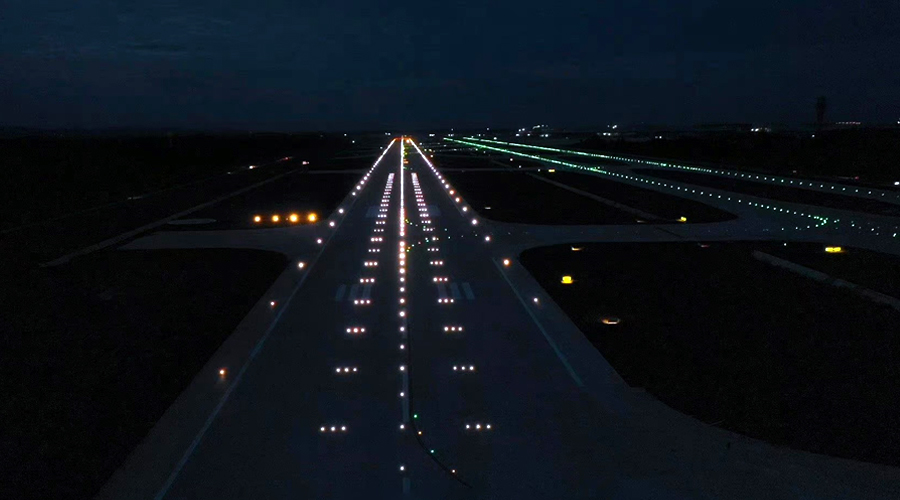
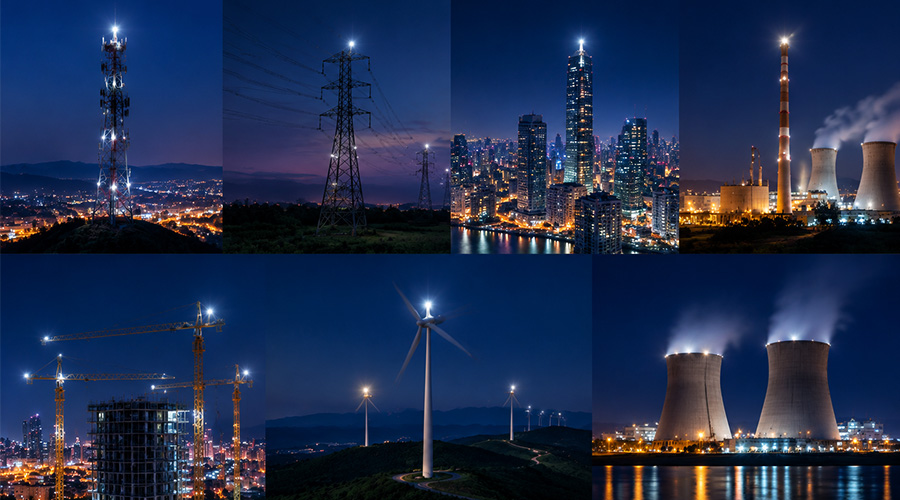
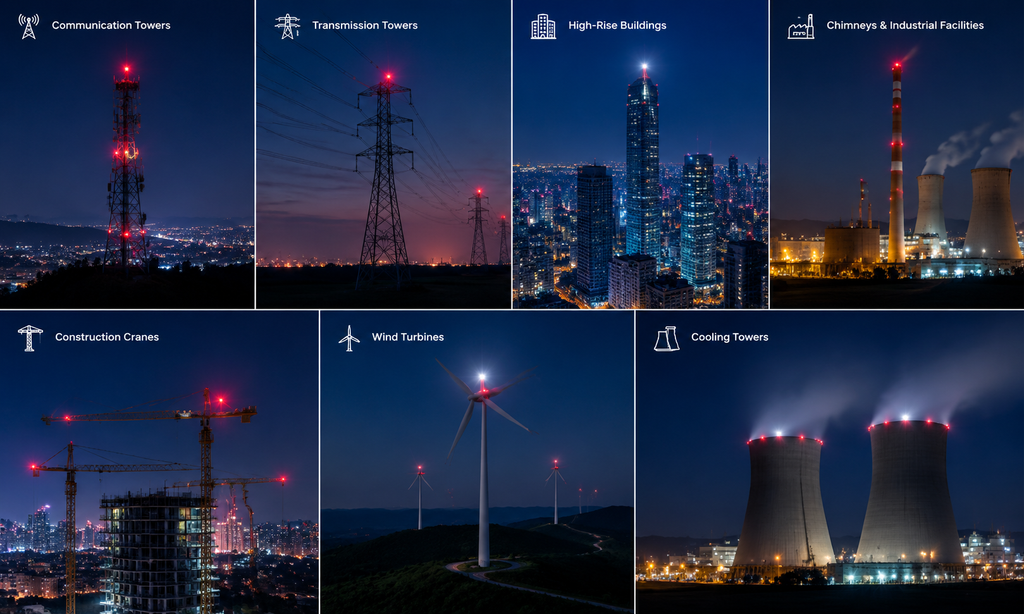
A Type A Medium Intensity Obstruction Light is designed for 105–150m high-rise buildings, communication towers, transmission towers, chimneys, cranes, cooling towers, wind turbines, and other tall structures. Its purpose is not simply to “turn on a light at night.” The actual factors that need to be considered include:
- How high is the structure?
- From which direction will aircraft approach?
- Does the structure need to be identified during daytime?
- What aviation requirements apply in the project location?
- Is there a stable power supply available on site?
These factors together determine whether a project requires: Low Intensity Obstruction Light / Medium Intensity Obstruction Light / High Intensity Obstruction Light and whether it requires different types such as: Type A Obstruction Light / Type B Obstruction Light
Among them, Type A Medium Intensity Obstruction Light is generally suitable for structures that require higher visibility while maintaining aviation identification during both daytime and nighttime. So, when should you consider Type A?
Type A Medium Intensity Obstruction Light Project Selection Guide
1. Consider Structure Height First, Not Only The Obstruction Light
When selecting an aviation obstruction light, structure height is usually the first factor that needs to be confirmed. For medium-height obstacles, a Medium Intensity Obstruction Lights is a common solution. According to specific project requirements and local aviation regulations, the selection should be based on a combination of: Structure height, Surrounding airspace conditions, Obstacle location, Flight environment etc, It should not be determined simply by one fixed height range. Examples include:
- Communication towers and microwave towers
- High-voltage transmission towers
- High-rise buildings
- Industrial chimneys and cooling towers
- Construction cranes
- Wind turbine systems
For projects around 105–150meters, once these structures reach a certain height, its necessary to consider how aircraft can identify the obstacle under different environmental conditions and distances. However, please note:
The actual type and installation quantity of aviation obstruction lights should follow the requirements of local aviation authorities, airports, or applicable regulations.
Especially for projects located near: Airports / Runways / Approach and departure routes / Other sensitive airspace areas, the selection cannot be based only on building height.

2. Why Consider Type A If Daytime Visibility Is Required?
This is one of the important differences between a Type A Obstruction Light and many conventional nighttime obstruction lights. A Type A Medium Intensity Obstruction Light uses white flashing light and can automatically switch between different intensity levels according to surrounding light conditions. Taking the YFFY-MI-A2 Solar Aviation Obstruction Light as an example:
- Daytime: ≥20,000 cd
- Nighttime: ≥2,000 cd
- 24-hour operation
- Automatic day/night mode switching
- White flashing mode
This means it is not simply: “A light that turns on after dark.” During daytime, when the background is bright and the structure outline is difficult for pilots to identify, higher white light intensity helps improve obstacle visibility. At night, the light intensity is reduced to a suitable level for nighttime operation. Therefore, if your project requires:
Daytime + Twilight + Nighttime continuous aviation obstruction marking
then a Type A aviation obstruction warning light is worth considering.
3. Which Projects Are Suitable For Type A Medium Intensity Obstruction Light?
A Type A Medium Intensity Obstruction Warning Light is not designed for only one type of structure. Based on different structural characteristics and application requirements, it can be used for various tall structures.
At the same time, a Solar Aviation Obstruction Light integrates solar panels, charging control systems, and batteries, allowing independent operation without external AC power. Under standard configurations, the fully charged battery can provide more than 100 hours of operation, with longer autonomy options available according to project requirements.
Therefore, for projects with: Remote locations / No available grid power / High-altitude installation Difficult cable installation, a Solar Obstruction Lights is especially worth evaluating.


1) Communication Towers And Power Towers
Including:
- 4G / 5G communication towers
- Microwave communication towers
- High-voltage transmission towers
- Power infrastructure
These structures usually have significant vertical height and are often installed in Suburban areas, Mountain regions, Remote locations
If convenient AC power is unavailable on site, a solar Type A solution is especially worth considering.
2) High-Rise Buildings
For high-rise buildings, the obstruction light type and installation layout should be determined according to: Total building height, Top structure, Surrounding building environment, Local aviation requirements.
If the building height and project requirements are suitable for a Medium Intensity Type A Obstruction Light, a white flashing obstruction warning light can be installed for top-level aviation marking.
For complex buildings, further considerations include:
- Location of the highest point
- Rooftop equipment
- Antennas or masts
- Building outline
- Whether multiple installation points are required
Therefore, do not simply purchase one solar obstruction warning light based only on total building height. Instead, the complete aviation obstruction marking plan should be considered.

3) Chimneys & Industrial Facilities
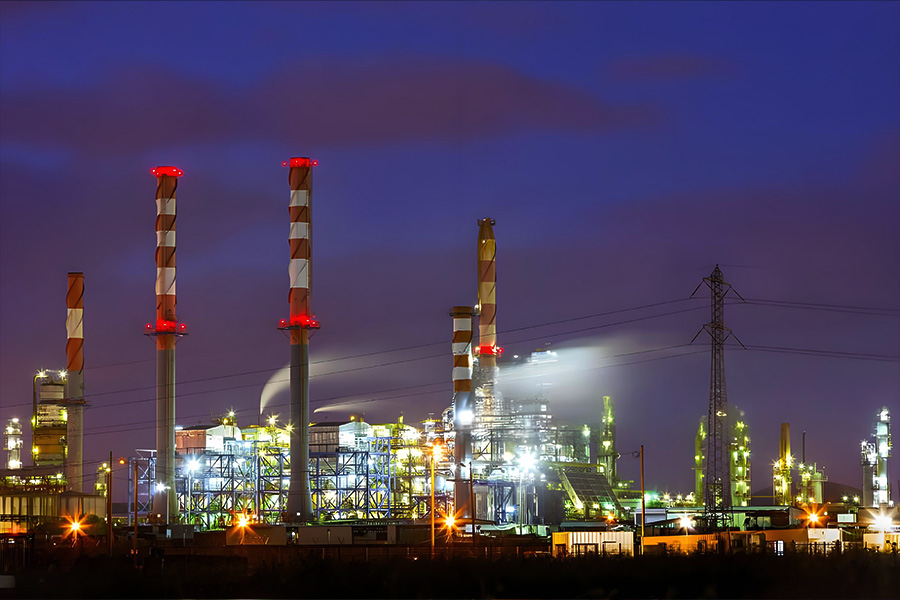
Common structures in large industrial projects include:
- Industrial chimneys
- Cooling towers
- Petrochemical facilities
- Factory towers
These structures are often relatively high and may be installed far away from urban power grids.
For these projects, in addition to: Light intensity and Light type, special attention should also be paid to: Waterproof performance, Corrosion resistance, Wind resistance, Long-term unattended operation capability.
The YFFY-MI-A2 Type A Medium Intensity Obstruction Light adopts an IP66 protection structure and uses a UV-resistant PC housing with a die-cast aluminum base. It can withstand wind speeds of up to approximately 240 km/h.
4) Wind Turbines
The hub height of large wind turbines can reach significant levels, and wind farms are usually located in remote areas. Therefore, wind turbine projects need to consider: Light intensity & Light type & Installation location. In addition, they need to consider:
Whether multiple aviation obstruction lights need synchronized flashing.
The YFFY-MI-A2 Solar Medium Intensity Obstruction Light is equipped with a GPS module, which can use satellite time signals to achieve wireless synchronization between multiple obstruction lights without additional synchronization wiring. For large wind farms or projects consisting of multiple tall structures, this feature is especially practical.
4. When Selecting A Type A Obstruction Light, Do Not Only Look At “2000cd”
When purchasing a Medium Intensity Obstruction Warning Light, a common misunderstanding is: “A product with 2000cd should be enough.”
In reality, project selection should not rely on only one light intensity value. It is recommended to confirm at least the following:
① Light Type
Whether it meets the project requirement: Medium Intensity Type A White Flash
② Daytime / Nighttime Intensity
Confirm whether the daytime and nighttime light intensity meet project requirements.
③ Flash Characteristics
Whether the flashing frequency complies with project requirements.
④ Horizontal Coverage
Whether it can meet the required horizontal visibility range.
⑤ Power Supply
Whether the power supply is: AC / DC / Solar / Hybrid Power Supply

⑥ Solar System Performance
If using a Solar Aviation Obstruction Light, confirm:
- How long it can operate during continuous cloudy or rainy conditions
- Battery capacity
- Solar panel configuration
⑦ Synchronization
For multiple-light installations: Whether GPS or other synchronization methods are required.
⑧ Environmental Protection
For high-altitude installation, also confirm:
- IP protection rating
- Operating temperature
- Wind resistance
- UV protection
- Corrosion resistance
These parameters are often more important than simply comparing prices.
5. What Types Of Projects Are Suitable For YFFY-MI-A2 Solar Aviation Obstruction Light?
If your project has the following characteristics:
- Structure height around 105–150 meters
- Requires Type A white flashing
- Requires daytime and nighttime operation
- No convenient AC power supply available
- High installation position and high maintenance cost
- Requires GPS synchronization between multiple lights
- Requires long-term outdoor operation
then the YFFY-MI-A2 Solar Type A Medium Intensity Obstruction Light can be considered. It uses CREE high-power LEDs with:
- Daytime light intensity ≥20,000 cd
- Nighttime light intensity ≥2,000 cd
- Independent solar power supply
- IP66 protection
- GPS synchronized flashing
The battery can provide more than 100 hours of operation after full charging, and longer autonomy configurations can also be provided according to project requirements. It can also be customized with optional features including:
- Li-ion / LiFePO₄ battery
- Dry contact alarm
- NVG-compatible IR LED
- Bird deterrent spike
FAQ About Type A Medium Intensity Obstruction Light
Q1. What Is The Difference Between Type A And Type B Medium Intensity Obstruction Light?
The most obvious difference is the light color and application purpose. Type A generally uses white flashing light and can be used for: Daytime, Twilight, Nighttime
Type B generally uses red flashing light and is mainly used for nighttime aviation obstacle marking. However, the final selection should not be based only on light color. It should also consider:
- Local aviation regulations
- Installation requirements
- Flight environment
Q2. Do Buildings Below 150 Meters Always Need Type A Obstruction Light?
Not necessarily. Structure height is only one factor in selection. Other factors also need to be considered:
- Whether the project is close to an airport
- Whether it is located near flight routes
- Terrain conditions
- Surrounding obstacles
- Local aviation authority requirements
- Aviation assessment results
Therefore: Below 150 meters Does Not Mean Type A is required.
Q3. Can Type A Medium Intensity Obstruction Light Be Used For Structures Above 150 Meters?
When a structure exceeds a certain height, the overall aviation obstruction lighting solution needs to be re-evaluated. The project may require: High Intensity Obstruction Light or Medium + High Intensity combination. Its recommended to provide:
- Structure height
- Installation location
- Country
- Distance from airport
The supplier can then confirm the appropriate configuration according to project requirements.
Q4. Is Solar Type A Obstruction Light Suitable For Remote Mountain Areas?
Yes. This is one of the typical application scenarios for a Solar Aviation Obstruction Light. If the installation site has: No grid power, Difficult cable installation, Complex terrain, Limited access for regular maintenance etc, an independent solar power system can reduce:
- Cable construction work
- Infrastructure investment
- Long-term maintenance costs
However, mountain projects should also evaluate:
- Solar radiation conditions
- Low winter temperatures
- Snow accumulation
- Continuous cloudy or rainy periods
If necessary, battery capacity should be increased.
Q5. Can Multiple Type A Obstruction Lights Flash Synchronously?
Yes. If a project requires multiple lights to flash synchronously, a model with synchronization capability should be selected.
GPS synchronization can reduce additional wiring requirements and improve installation convenience for large projects.
Q6. What Information Should Be Provided Before Purchasing A Type A Solar Aviation Obstruction Light?
It is recommended to provide at least:
- Structure height
- Structure type
- Installation location / country
- Distance from airport or flight path
- Number of lights required
- AC power availability
- Local climate conditions
- Required autonomy time
- ICAO / FAA / local authority requirements
Conclusion
Choosing a Type A Medium Intensity Obstruction Light is not simply about asking: “Is my structure high enough?” Instead, the selection should be based on a comprehensive evaluation of:
- Structure height
- Airspace environment
- Daytime and nighttime visibility requirements
- Local aviation requirements
- Power supply conditions
- Installation environment
- Long-term maintenance considerations
For projects involving multiple light installations, the following factors should also be included in the selection process:
- GPS synchronization
- Operating autonomy
- Environmental protection
- Fault monitoring
The selection should not only focus on the product price, but also consider the overall reliability, installation conditions, and long-term operation requirements of the aviation obstruction lighting system.