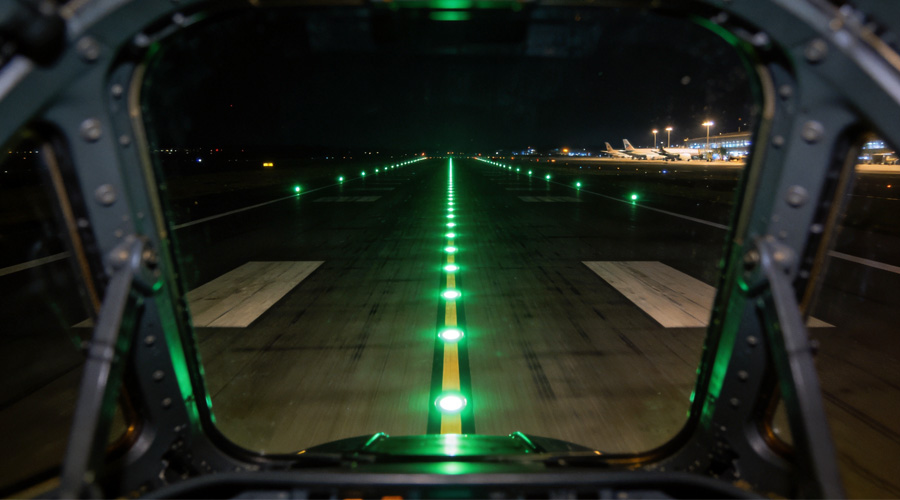
Airport Taxiway Centerline Lights: The Most Reliable “Ground Navigator” for Aircraft Night Taxiing
At an airport shrouded in night or heavy fog, how do pilots accurately taxi from the runway to the parking stand without taking the wrong turn? The answer lies in those small green inset lights embedded in the pavement – taxiway centerline lights. These unassuming fixtures are the core safety facility for aircraft ground movement.
This article systematically introduces the core functions, international installation standards, real-world global application cases, and the comprehensive benefits that taxiway centerline light bring to airports.
1. What Are Taxiway Centerline Lights?
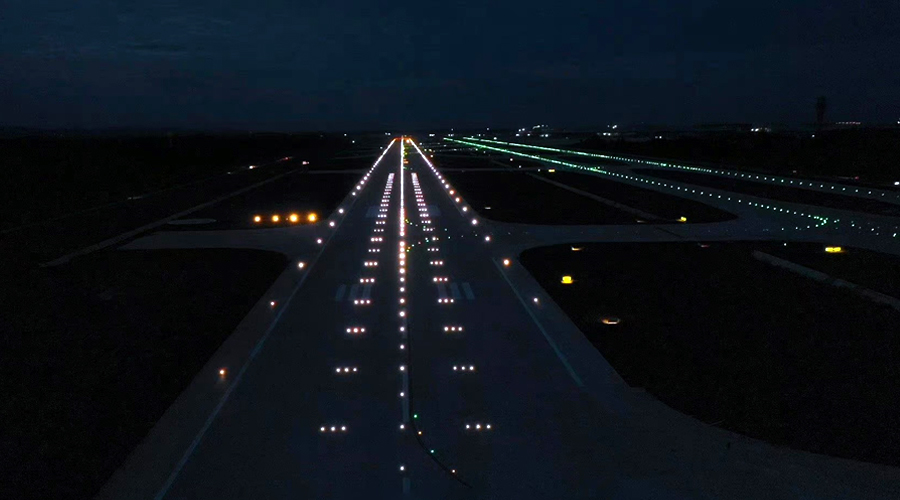
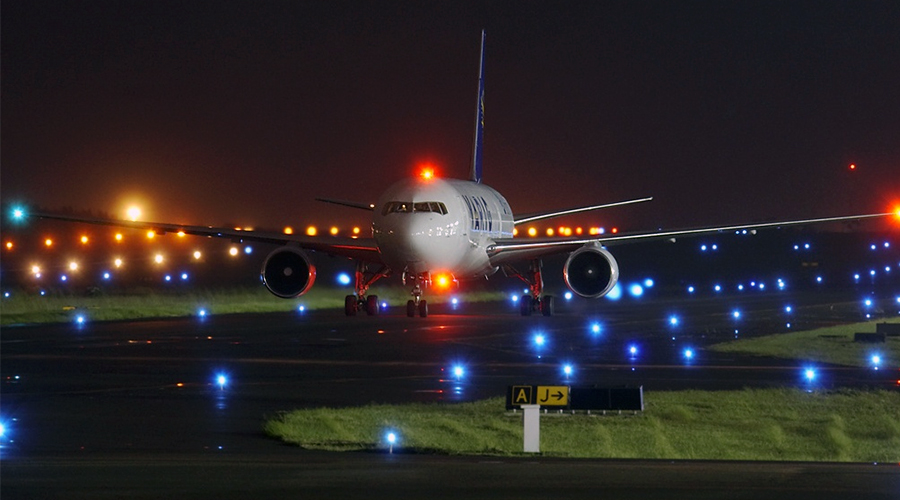
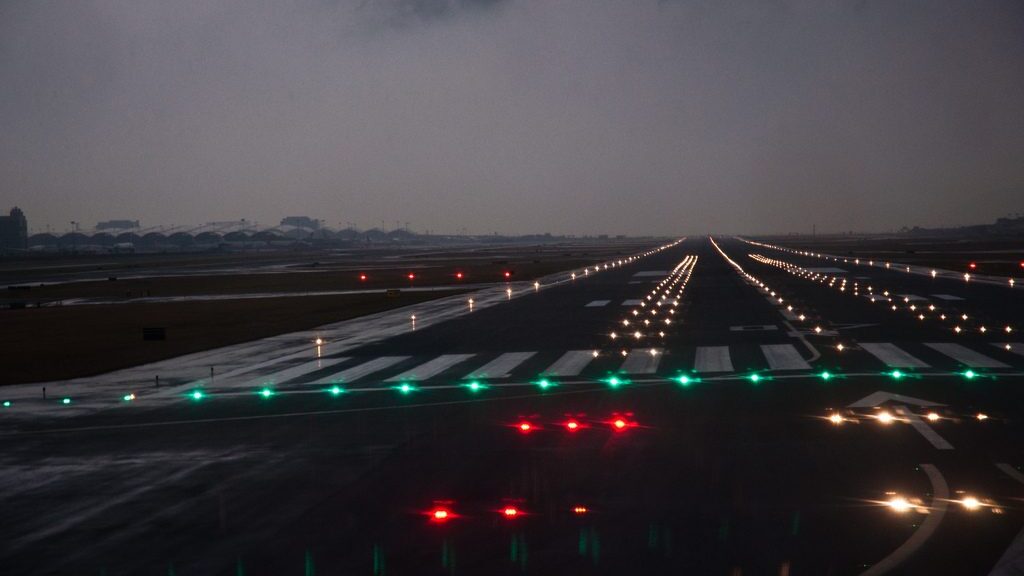
Airport centerline lights are green lights embedded along the centerline of a taxiway. Their purpose is to provide pilots with a clear and accurate taxi path reference during night operations or low-visibility conditions (such as heavy fog, heavy rain, snow, etc.).
Distinct from the white runway centerline lights, taxiway centerline lights use standard aviation green, allowing pilots to instantly distinguish the taxiway from the runway and avoid entering dangerous areas.
Modern airports are increasingly adopting LED taxiway centerline light. Compared to traditional halogen lamps, their performance is comprehensively improved:
- Light intensity can reach over 200cd, remaining clearly visible even in severe weather with RVR (Runway Visual Range) below 400 meters.
- LED lifespan reaches 50,000 to 75,000 hours – about 15 times that of halogen bulbs (1,000 to 5,000 hours).
- Energy consumption is reduced by 70% to 80%, significantly cutting electricity bills and carbon emissions.
- Achieves IP68 highest protection rating – the fully sealed structure allows stable operation even when submerged in standing water or de-icing fluids for long periods.
2. International Standard Installation Requirements
The installation of airport taxiway lights – centerline lights must strictly comply with technical specifications such as ICAO Annex 14 and FAA AC 150/5345-46. The following are key installation requirements:
2.1 Spacing Requirements
- Straight sections: The spacing between centerline lights generally doesn’t exceed 60 meters to ensure pilots see a continuous band of light.
- Curved sections: Spacing must be significantly reduced. For curve radii between 75 and 399 feet (approx. 23–122 meters), FAA specifies a typical spacing of 12.5 feet (approx. 3.8 meters) for L-852D type lights, ensuring pilots can see at least three lights from the cockpit and obtain clear curved path guidance.
- Low-visibility taxi conditions (RVR below 350 meters): ICAO recommends reducing the longitudinal spacing of centerline lights to no more than 15 meters to provide a denser guidance light band.
2.2 Inset Installation & Leveling
Airfield ground lighting must be installed flush with the pavement surface. According to FAA AC 150/5340-30, the lights must remain level, and the height of the outer edge of the top surface relative to the surrounding pavement must be controlled within +0 inch to -1/16 inch (approx. 0 to 1.5875 mm).
Any installation deviation beyond the permitted range will cause beam angle errors, weaken guidance effectiveness, and even shorten the life of the airport lights.
2.3 Applicable Standards
Compliance with ICAO Annex 14 Volume I Part 4, FAA AC 150/5345-46 current edition, NATO STANAG 3316, and other international standards.

3. Real-World Application Cases of Taxiway Centerline Lights
The following four airport cases of different scales and regions demonstrate the practical effects of airport centerline lights worldwide. Each case describes the airport profile, number of lights installed, layout characteristics, and operational improvements after upgrade.
Case 1: Birmingham Airport (BHX) – Full Taxiway LED Conversion
Airport & project overview: Birmingham Airport is a major regional international airport in the UK, with a 3,052-meter runway and annual passenger throughput exceeding 10 million. In October 2025, the airport completed the LED upgrade of all taxiway lighting, fully replacing traditional halogen bulbs with LED lights.
Number of lights installed and layout: Approximately 1,200 LED airport lights cover the entire taxiway system, including centerline lights and edge lights. The airfield ground lighting project was carried out in phases by area, completed during night flight gaps, which imposed high demands on construction organization.
Operational improvements: After upgrade, it saves over 316,400 kWh of electricity annually and reduces carbon emissions by 66 tons, helping the airport achieve its 2033 net-zero emission target.
Case 2: Auckland Airport (AKL) – Full Runway and Taxiway LED Conversion
Airport & project overview: Auckland Airport is New Zealand’s busiest international gateway, with a 3.6 km runway. In 2024, it completed an LED lighting upgrade project with a total investment of approximately NZ$70 million.
Number of lights installed and layout: A total of 600 LED airport warning lights were installed, including runway centerline lights, taxiway lights, and apron areas. Construction was strictly limited to the night maintenance window of 1:30–4:30 am. LED light lifespan reaches 75,000 hours – 15 times that of halogen lamps (5,000 hours).
Operational improvements: Energy consumption of the LED warning lights dropped by about 70%. After runway conversion was complete, the airport immediately launched a systematic upgrade of the remaining thousands of halogen lamps covering taxiways, aprons, and parking stands.
Case 3: Denver International Airport (DEN) – FAA’s Largest Taxiway Centerline Lights Safety Project
Airport & project overview: Denver International Airport is one of the busiest airports in the world, with 6 runways. In 2023, it completed a taxiway safety improvement project with a total investment of approximately US$50.9 million, fully funded by the FAA.
Number of lights installed and layout: The project included the installation of 2,300 upgraded LED lights, covering a full range of visual aids: taxiway centerline lights, edge lights, runway guard lights, stop bars, etc. A new taxiway of 2,500 feet (approx. 762 meters) was built, eliminating an FAA-designated high-risk “hot spot” intersection.
Operational improvements: The taxiway upgrade improved ground movement efficiency by 10% and eliminated aircraft‑runway conflict risks. The airport continues to push forward LED conversion of all its lighting systems.
Case 4: China Erlianhot Airport – Energy Saving Retrofit for a Small/Medium Airport
Airport and project overview: Erlianhot Airport is a regional feeder airport in northern China. During a special period a few years ago, it completed LED conversion of its taxiway edge lights.
Number of lights installed and layout: The original halogen taxiway edge lights in the airside area were replaced with LED lights. The airport also planned further upgrades for other lighting sections. The power per light dropped from 48 watts to 9 watts, saving nearly 80% in energy.
Operational improvements: After retrofit, the airport saves approximately 92,100 kWh of electricity annually, a year-on-year reduction of 21.27%.
4. 5 Major Advantages of LED Taxiway Centerline Lights
- Enhances flight safety:
High‑brightness green guidance provides a clear centerline reference in low visibility.
Denver Airport’s 2,300‑LED upgrade directly eliminated an FAA‑designated high‑risk hot spot and improved ground efficiency by 10%. - Reduces operating costs:
Energy consumption is only one‑fifth to one‑third of conventional airport ground lighting, dramatically lowering electricity bills.
The ultra‑long LED lifespan means no lamp replacement for 5–10 years, significantly reducing maintenance labor and pavement closure time. - Improves airport operational efficiency:
Clear guidance light bands help pilots identify taxi routes faster and more accurately.
After Denver’s new taxiway opened, ground movement efficiency increased by about 10%. - Environmentally friendly and sustainable:
Birmingham Airport alone reduces 66 tons of carbon emissions annually just from taxiway LED conversion. Mercury‑free design and compatibility with solar power systems help airports achieve carbon neutrality goals. - Global standard compatibility and flexible deployment:
Compliant with ICAO, FAA and other major international standards, supports multiple power supply types and base sizes, and adapts to all runway systems from small regional airports to large international hubs.

Though only small inset lights on the pavement, airport taxiway centerline lights are the “lifeline” for safe aircraft ground movement.
From Birmingham in the UK to Auckland in New Zealand, from Denver in the US to Erlianhot in China, the worldwide practice of LED conversion repeatedly confirms the same conclusion: modern LED taxiway centerline lights are the most worthwhile investment direction for airport infrastructure upgrades.
Planning a new airport or lighting retrofit? Choosing LED taxiway lights that meet international standards and feature high protection ratings not only provides the most reliable guarantee for flight ground taxi safety but also translates into long‑term measurable economic and environmental benefits.
About the YFFY-HP/TC Airport Taxiway Centerline Lights
This airport light is an inset LED taxiway centerline light compliant with ICAO and FAA standards. It delivers standard aviation green light, with IP68 protection rating and a wide operating temperature range of -40°C to +60°C.
For more product parameters, installation solutions, or to request a quote, please feel free to contact our professional team.