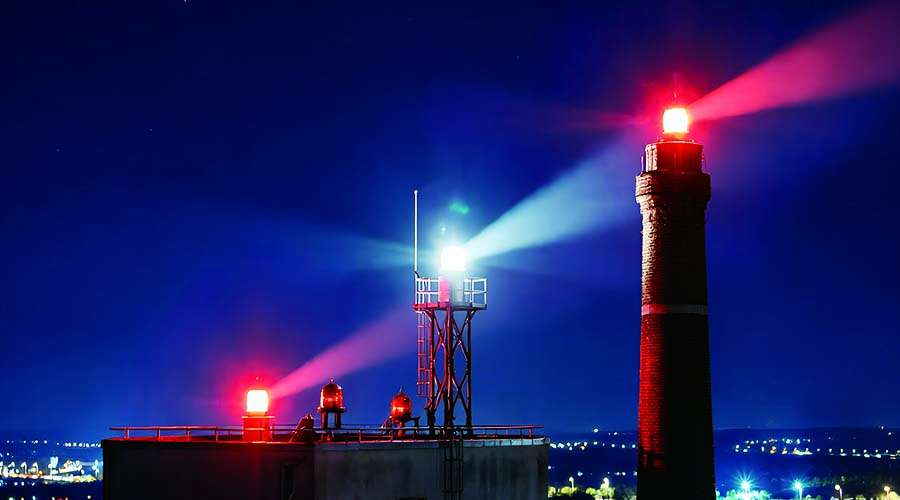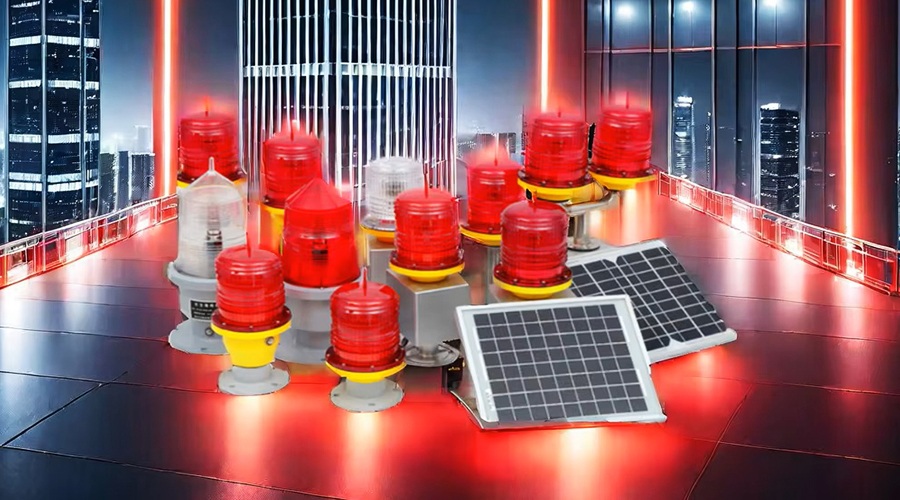

Tower Solar Lights – As the name suggests, these solar-powered warning lights are used on towers to provide warnings to high-altitude aircraft and pilots, and also serve as identification for the tower.
How to Choose the Right Tower Solar Lights?
When selecting the right solar warning light for communication towers, high-rise towers, telecommunications towers, and other equipment, consider evaluating and comparing the following key aspects.
1. Color & Signal Requirements
- Common colors: red, orange, yellow-green, and white. The specific color depends on the intended use (collision avoidance, warning, indication, etc.) and local regulations or industry standards.
- Flashing Modes: Multiple flashing modes (such as slow flash, fast flash, and steady on) can provide different visibility distances and identification levels. Be aware of local regulations regarding flashing frequencies and ensure that aviation obstruction lights have either a compliant mode or a switchable mode.
2. Light Intensity Visibility
- Key testing points: Is the light intensity clearly identifiable at the target visibility distance (usually measured in meters)?
- Influencing factors: Sunlight, weather, and viewing angle. Choose solar lights with adjustable light intensity and day/night switching. Prioritize high brightness and wide-angle light distribution at night.
3. Power Supply & Energy Management
- Solar panel power rating: This must match the load (power consumption, flashing pattern, and operating time of the solar aviation obstruction warning light) to ensure normal operation even on cloudy or rainy days.
- Battery type and lifespan: Lead-acid, lithium-ion, or nickel-metal hydride batteries vary in capacity, cycle life, and weight. Choose battery packs with good low-temperature performance and long cycle life to ensure reliability in extreme climates.
- Charge and Discharge Protection and Energy Management: Features such as MPPT/PWM control, low-temperature start-up, over-discharge protection, and temperature compensation should be included.
4. Reliability & Environmental Adaptability
- Protection Rating: This includes IP rating (e.g., IP65, IP66) and corrosion resistance (e.g., resistance to salt spray).
- Wind-Resistant Design: Communication towers are often exposed to strong winds, so solar aviation obstruction lights should have a high-strength casing and anti-loosening fasteners.
- Operating Temperature Range: Confirm that the LED communication tower solar lights can operate within the tower’s extreme temperature range.
- Waterproof and dustproof performance, and earthquake/impact-resistant structure.
5. Installation & Wiring Requirements
- Mounting Methods: Wall-mount, pole clamp, cantilever, etc., ensuring ease of installation and maintenance on the tower.
- Wiring and Waterproof Connectors: Waterproof connectors, short-distance wiring, and easily maintained connectors are preferred.
- Angle Adjustment and Alignment: Some obstruction warning lights offer adjustable angles to ensure coverage and visibility.
6. Monitoring & Maintenance
- Monitoring Methods: Whether remote monitoring is supported (via wireless transmission, module self-test, LED indicator status, etc.).
- Maintenance Interval: Battery life, lamp head replacement cycle, and cleaning requirements (contamination-resistant, easy-to-clean exterior surface).
- Self-Test and Alarms: Fault self-test, low battery, shading, and other alarm functions.
7. Recommended Selection Procedures for Practical Applications
- Determine site conditions: Tower height, wind speed, hours of sunshine, temperature range, altitude, and salt spray levels (e.g., towers near the sea).
- Identify regulations and standards: Understand local requirements for warning light color, flashing frequency, and minimum visibility distance.
- Set performance metrics: Target visibility distance, operating hours/day, minimum operating temperature, and required battery life.
- Field trials and validation: If conditions permit, conduct small-scale trials to observe performance under various weather conditions.
- Plan maintenance cycles: Create an annual schedule for cleaning, inspection, and battery and lamp head replacement.
If you prefer, we can provide a customized selection list and candidate model list based on your specific scenario, or we can help you compare key parameters of several models you’re already considering to select the tower solar lights that’s right for you.