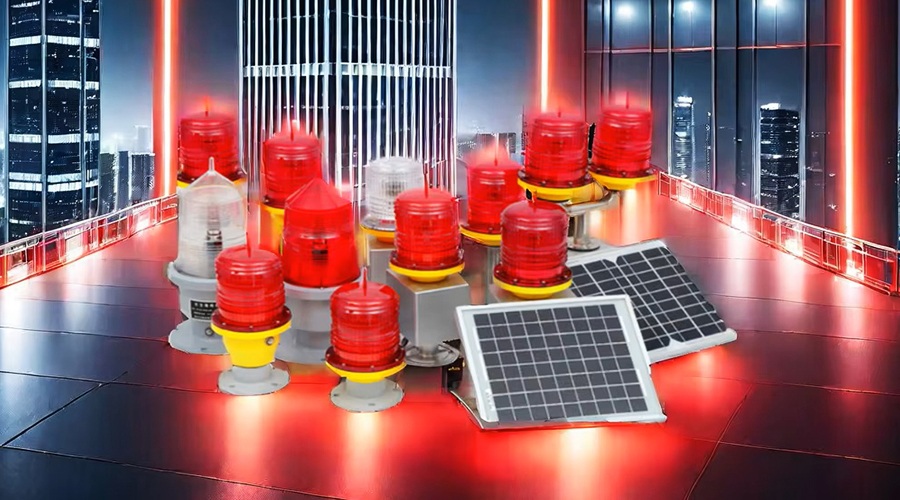

Solar warning lights the application on airport light towers primarily focuses on providing nighttime warnings and aiding navigation.
Powered by solar energy, these solar lights are energy-efficient, environmentally friendly, and independently operated, requiring no power grid connection. They are commonly installed on various towers at airports, such as communication towers and wind vane towers, to enhance visibility and ensure flight safety.
Furthermore, solar LED warning lights have relatively low installation and maintenance costs, making them an ideal choice for airport light towers. They typically utilize red LEDs for enhanced visibility at night or in low-visibility conditions.
Benefits of Solar Warning Lights For Airport Light Towers
Airport light towers, also commonly known as airport lighting towers, are a vital component of airport infrastructure.
They provide clear visual guidance for aircraft taking off and landing, especially at night, in low visibility, or in inclement weather.
The design and layout of light towers must strictly adhere to ICAO standards to ensure flight safety. Furthermore, proper maintenance is crucial to ensure proper operation and extend their service life.
The application of LED solar-powered warning lights to airport light towers offers several significant advantages, particularly in improving safety, sustainability, and operational efficiency. These advantages are as follows:
1. Independent Power Supply & Ultra-High Reliability
No Grid Dependence: Utilizing a solar power + battery storage system, these lights completely eliminate the constraints of utility power supply and the risk of light outages due to grid failures.
Applicable Scenario: Remote airports/temporary landing and take-off sites/emergency backup power sources—perfectly addressing power supply challenges in off-grid environments.
Mobile Application: Portable versions are suitable for short-term construction sites or emergency rescue operations.
2. Energy Saving & Emission Reduction: Low Carbon Emissions
Zero Carbon Emissions: No fossil fuels are required for operation, aligning with airport carbon reduction goals (Note: Aviation accounts for approximately 3% of global carbon emissions).
Data Support: A single set of solar-powered airport warning lights can reduce carbon emissions by several tons annually, contributing to airports’ LEED certification goals.
3. Low-Cost, Long-Term Operation
Manageable Initial Investment: While the initial cost is higher than traditional airport lights, the high cost of laying cables (which can account for 40%-60% of the total budget) is eliminated.
Ultra-low maintenance costs: The LED light source has a lifespan of over 50,000 hours, and the lithium battery has over 2,000 cycles, significantly reducing replacement frequency.
Comparative case study: After renovation, a medium-sized airport saw a 70% reduction in operating and maintenance expenses within five years, shortening the payback period to less than three years.
4. All-Weather Intelligent Control
Adaptive Lighting Management: Integrated photosensors and infrared motion sensors automatically turn lights on at dusk and off at dawn, maintaining constant brightness even in extreme weather conditions.
Harsh Environment Resilience: The IP68 protection rating withstands heavy rain and salt spray corrosion, and the seismic-resistant structure is suitable for earthquake-prone areas.
Low-Temperature Protection: The wide-temperature range lithium battery (-40°C to +85°C) ensures stable operation even in the extreme cold of northern China.
In summary, solar warning lights are more than just a simple replacement; they are strategic equipment that drives airports towards a safer and lower-carbon future.
Their comprehensive benefits are reflected in multiple dimensions, including increased safety margins, optimized lifecycle costs, and a strong image of sustainable development. They have become a standard feature in modern airport construction.