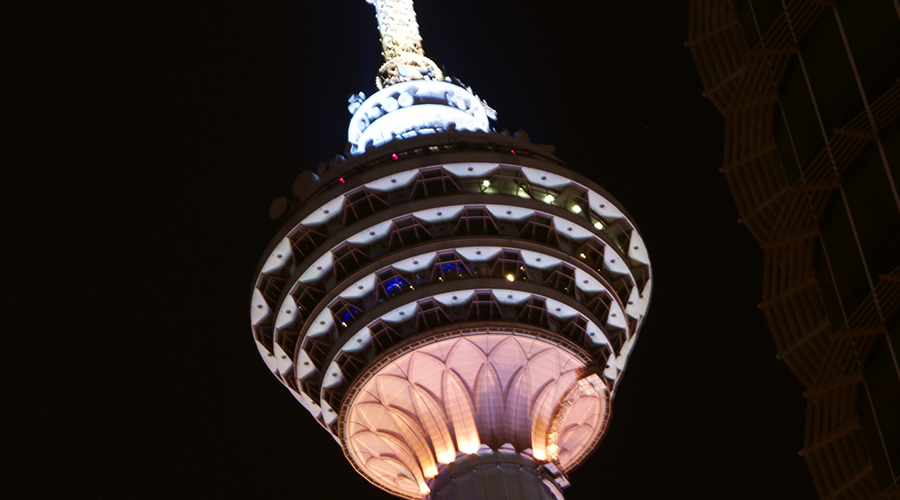
Where Are High Intensity Obstruction Warning Lights Most Advantageous?
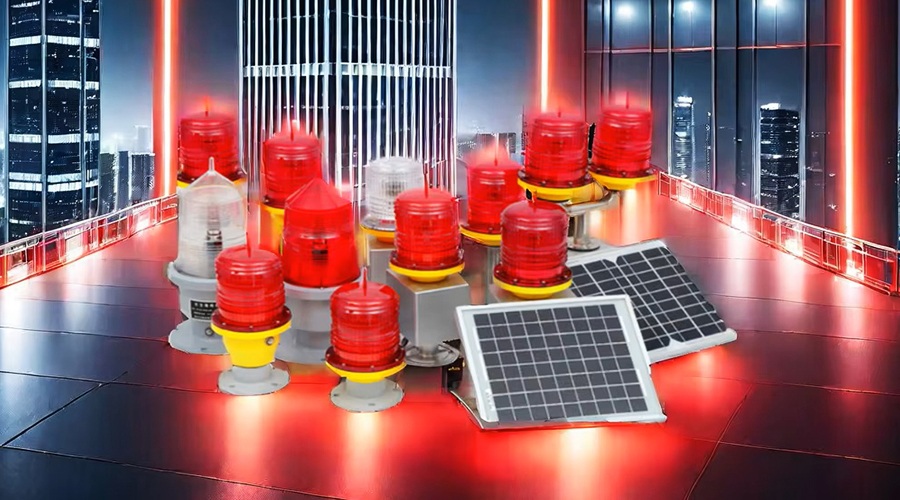
High intensity obstruction lights are the highest warning level in aviation obstruction lighting systems. They are specifically designed for structures exceeding 150 meters in height or those posing special aviation risks.
They are commonly installed on skyscrapers, bridges, mountain peaks, and other tall structures. With horizontal beam spread angles of 90° or 120°, multiple lights can be combined to achieve full 360° coverage.
High-intensity aviation obstruction lights operate with specific flash frequencies and durations in compliance with ICAO international civil aviation standards.
Their core value lies in providing significantly higher brightness and reliability than ordinary obstruction lights, ensuring aircraft safety clearance even under complex background lighting conditions. Depending on the structural characteristics and operational requirements of different projects, high-intensity aviation obstacle lights demonstrate outstanding advantages in the following key applications.

Advantages of High Intensity Obstruction Lights
1. Super High-Rise Buildings
According to ICAO Annex 14 and related standards, buildings taller than 150 meters must install high intensity obstruction lights at the top, with intermediate levels added at intervals not exceeding 50m (CAAC standard).
Super high-rise buildings are usually located in city centers where nighttime background lighting is extremely strong due to urban illumination and LED curtain walls. Low or medium intensity obstruction lights can easily be overwhelmed by ambient light.
High intensity Type A lights operate 24/7, delivering:
- 200,000 cd during daytime
- 20,000 cd at twilight
- 2,000 cd at night
They use white flashing signals with a flash rate of 40–60 flashes per minute, remaining clearly visible even in strong urban lighting environments.
Key Advantages of High Intensity Obstruction Lights
- Excellent resistance to background light interference
The stronger the urban light pollution, the more essential high-intensity lights become. - Long-distance visibility
Effective recognition distance can reach dozens of kilometers, giving pilots more reaction time. - 360° full coverage
Multiple aviation obstacle lights with 120° beam angles provide complete no-blind-zone coverage.
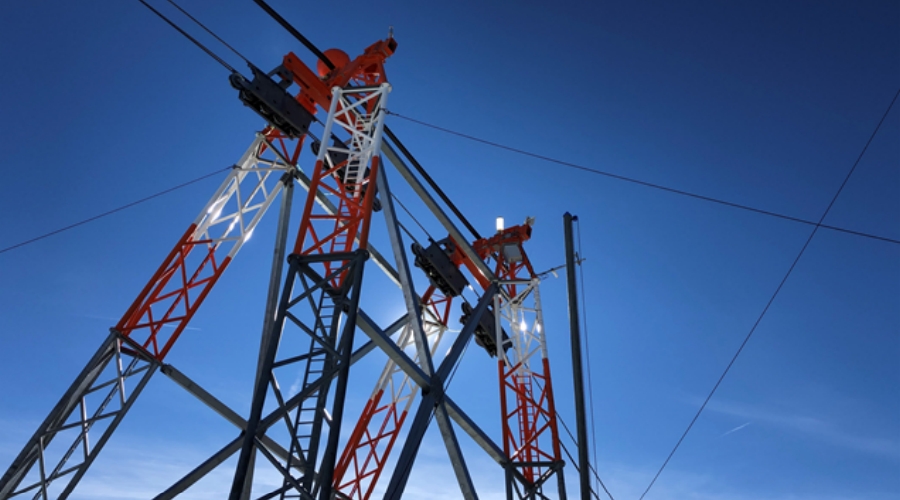
2. Extra High Voltage Transmission Towers
Extra high voltage transmission towers represent one of the most specialized applications for aircraft warning lights.
Standards require high intensity Type B obstruction warning lights with synchronized three-level flashing, installed at:
- The tower top
- The lowest point of the power cable sag
- The midpoint between the two
The lights must also face outward along the cable direction.
Unique Advantages
- Continuous linear warning system
Transmission lines crossing valleys and rivers may extend for several kilometers. Synchronized flashing creates a continuous visual warning chain. - Sequential flashing synchronization
Multiple towers can flash sequentially through a control system, clearly outlining cable routes and preventing pilots from misjudging cable height. - Excellent solar power compatibility
Since many transmission towers are located in remote mountainous areas, solar obstruction lights offer reliable independent operation.
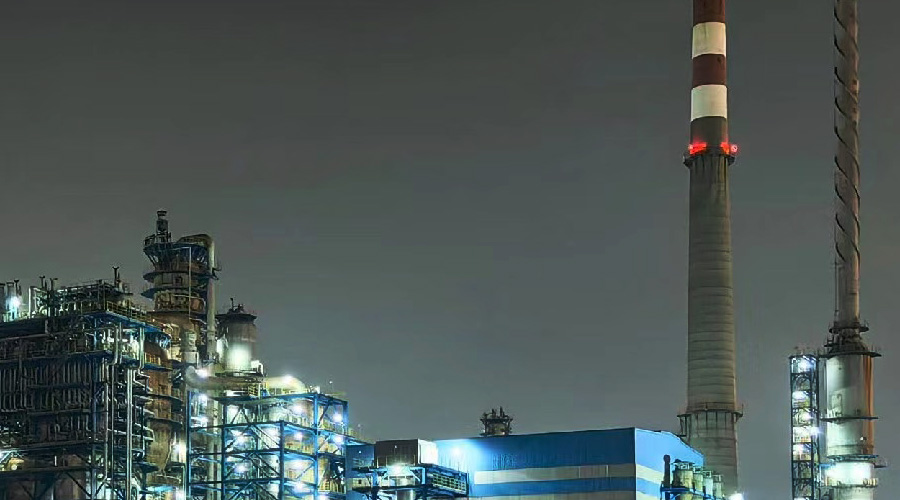
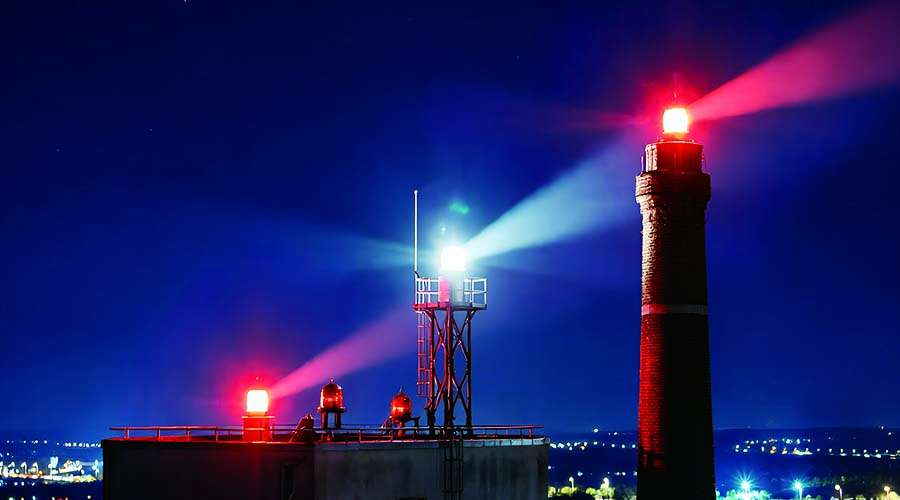
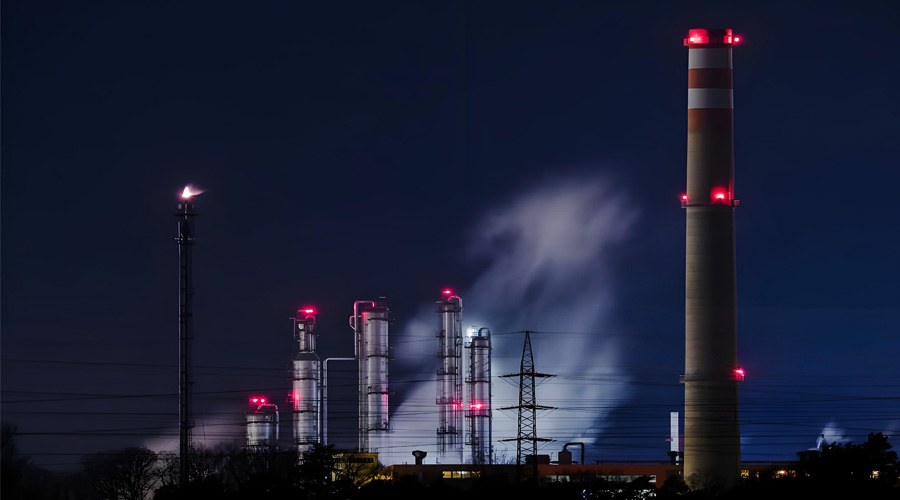
3. Chimneys & Industrial Exhaust Stacks
Industrial chimneys can reach heights of 200–300 meters or more and often operate in harsh environments involving:
- High temperatures
- Corrosive gases
- Continuous vibration
Standards specify that when chimney height exceeds 150m, high intensity obstruction light must be installed at the top and at intervals of 75–105 meters. Medium intensity lights are typically added between high intensity levels.
These high altitude obstruction lights must withstand temperatures of at least 80°C and are generally installed away from exhaust outlets.
Main Advantages
- No need for red-and-white paint markings
When white high intensity flashing lights are used, traditional aviation paint markings can often be eliminated, reducing maintenance costs. - Automatic day/twilight/night intensity switching
The lighting system automatically adapts to fog, haze, cloudy weather, and varying visibility conditions. - High-temperature resistant design
Most fixtures use high-strength aviation-grade aluminum alloy housings with advanced heat dissipation structures.
4. Offshore Wind Farms & Wind Turbines
Modern wind turbines frequently exceed 150 meters in total height, including blades and tower structures. They are typically located in coastal, offshore, or open plain environments.
Wind farms form large-scale aerial obstacles due to dense turbine arrangements.
Standards require two aviation obstruction warning lights on top of the nacelle, with spacing greater than the blade width. The lights on the same turbine must flash synchronously.
Significant Advantages
- Reduced blade shadowing effect
Dual-light installation ensures that at least one obstruction light remains visible at all times. - Resistance to harsh marine environments
Protection levels of IP65 or higher are required to withstand salt spray, strong winds, and heavy rain. - Cluster synchronization control
GPS or master-slave systems allow multiple turbines to flash simultaneously, clearly defining the wind farm boundary. - Low maintenance requirements
LED light sources typically exceed 100,000 operating hours, reducing offshore maintenance frequency and operational costs.
5. Large Bridges
Large bridges crossing rivers or straits may have tower heights of 200–300 meters and wide spans that pose significant risks to low-altitude aircraft.
According to standards:
- High intensity obstruction lights must be installed at bridge tower tops
- Medium or low intensity lights are installed along both sides of the bridge deck at intervals of 60–90 meters
Core Advantages
- Clear identification of bridge tower high points
High intensity Type A or Type B lights enable pilots to recognize clearance restrictions from long distances. - High wind resistance and weather durability
Bridge lighting systems must withstand strong winds (often requiring wind resistance ≥240 km/h), vibration, and salt corrosion. - Solar power reduces cabling costs
Independent solar-powered high intensity lights are especially suitable for bridge tower tops far from power sources. - Three-dimensional warning effect
High intensity top lights combined with bridge deck contour lights create a complete spatial outline of the bridge.
6. Mountain Peaks and Remote Elevated Structures
Remote mountainous areas often contain:
- Communication base stations
- Weather radar stations
- Broadcasting towers
Although located far from urban areas, these structures must still be marked on aviation navigation charts and equipped with aviation obstruction lights.
Outstanding Advantages
- Independent solar power supply
Solar panels and battery systems allow year-round operation without grid power access. - Remote monitoring and maintenance
GPS synchronization and remote alarm systems reduce the need for frequent mountain inspections. - Low-power LED technology
Power consumption is typically only a few dozen watts, making solar operation highly practical. - Easy transportation and installation
Lightweight integrated systems can be transported by helicopter or manual carrying, greatly reducing construction difficulty.
Comparison of High Intensity Obstruction Lights Applications
| Application Scenario | Recommended Light Type | Main Installation Requirements | Solar Compatibility |
|---|---|---|---|
| Super high-rise buildings (≥150m) | High Intensity Lights Type A (White Flashing) | Intermediate spacing ≤50m, 360° coverage | ★★★ |
| Extra high voltage towers | High Intensity Lights Type B (Red Flashing) | Three-level synchronized flashing | ★★★★★ |
| Chimneys / Exhaust stacks (≥150m) | High Intensity Type A or B | 75–105m spacing, avoid exhaust outlet | ★★★★ |
| Offshore wind turbines | High Intensity Type B | Dual-light installation, spacing > blade width | ★★★★ |
| Large bridges | High Intensity Type A or B | Tower-top installation with contour lights | ★★★ |
| Mountain peaks / remote sites | High Intensity Type B | GPS synchronization, remote monitoring | ★★★★★ |
The key advantages of high-intensity obstruction lights include:
- Ultra-long visibility distance
- Multi-level automatic intensity adjustment
- Reliable all-weather operation
For remote locations where grid power is unavailable or maintenance costs are extremely high, solar-powered high intensity obstruction lights are often the ideal solution, balancing aviation safety with long-term economic efficiency.
When selecting an aviation obstruction lighting system, factors such as:
- Exact structure height
- Airspace classification
- Local climate conditions
- Rainfall levels
- Sunshine duration
- Maximum wind speed
should all be carefully evaluated to determine the most suitable lighting model and installation solution.
High Intensity Obstruction Lights Case Show