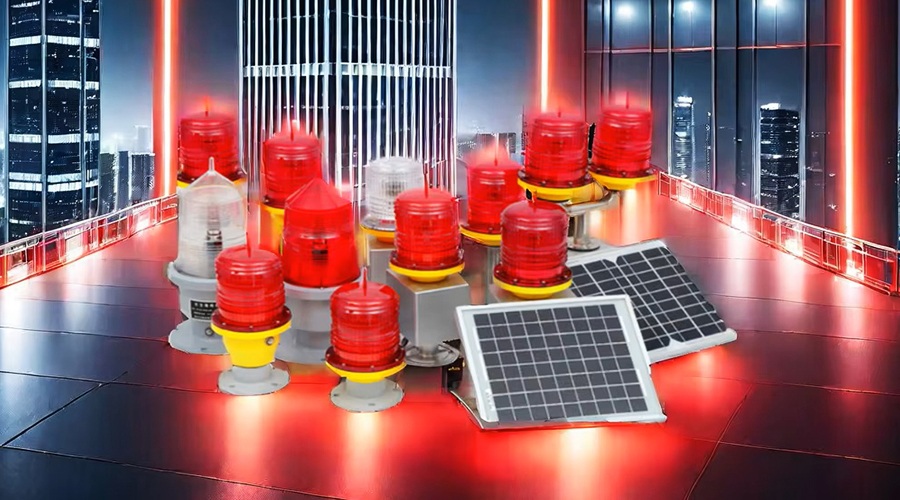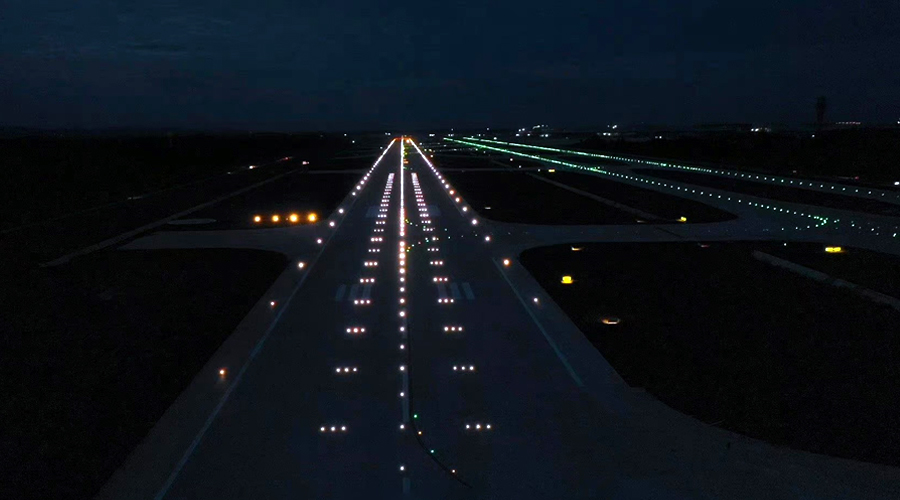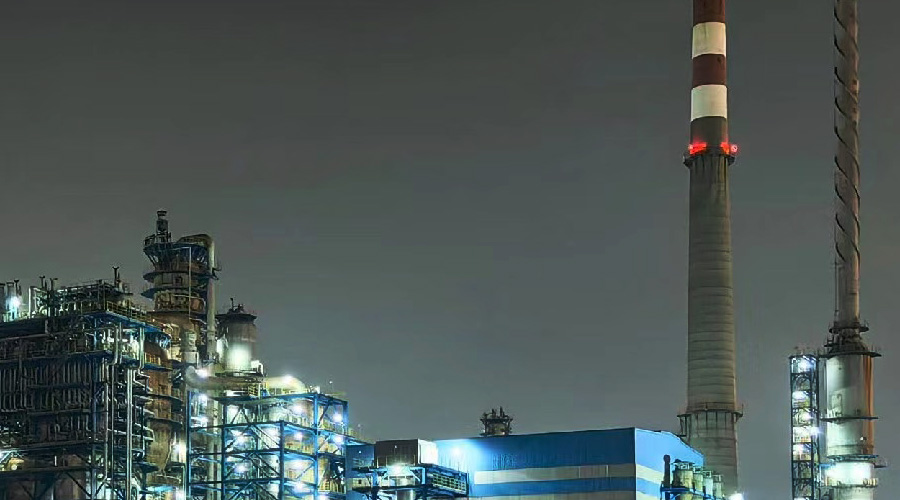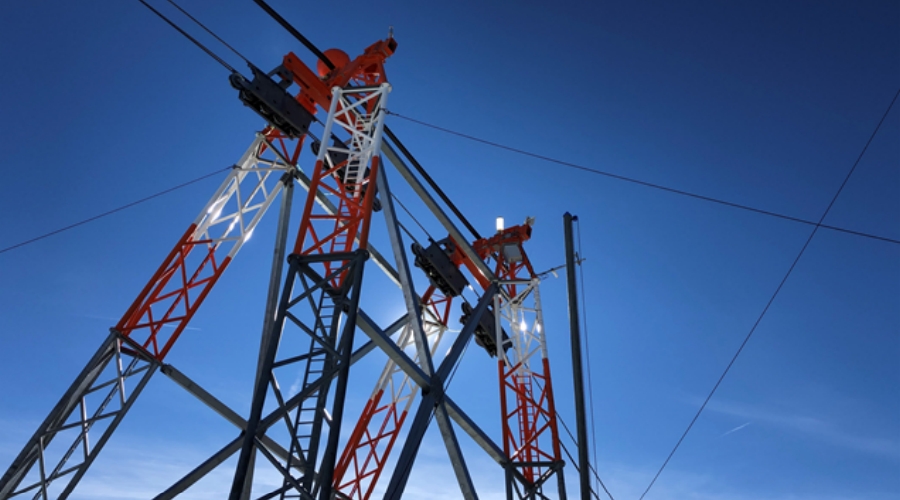
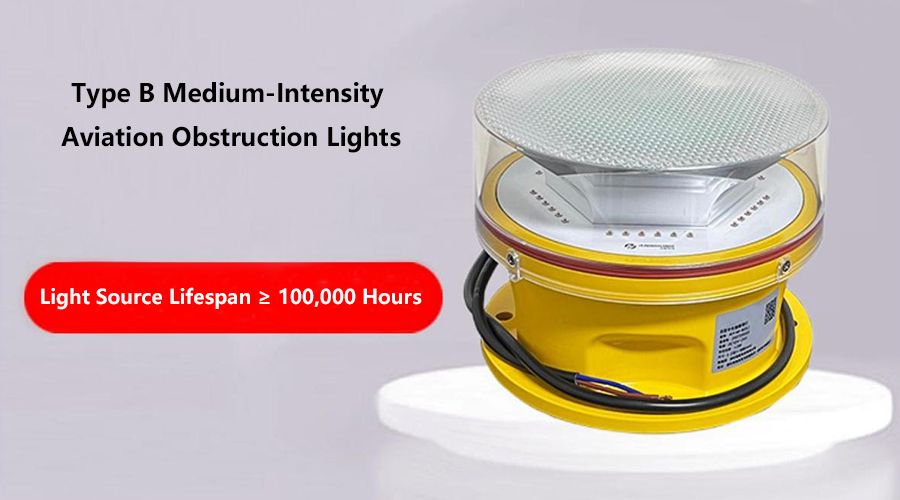
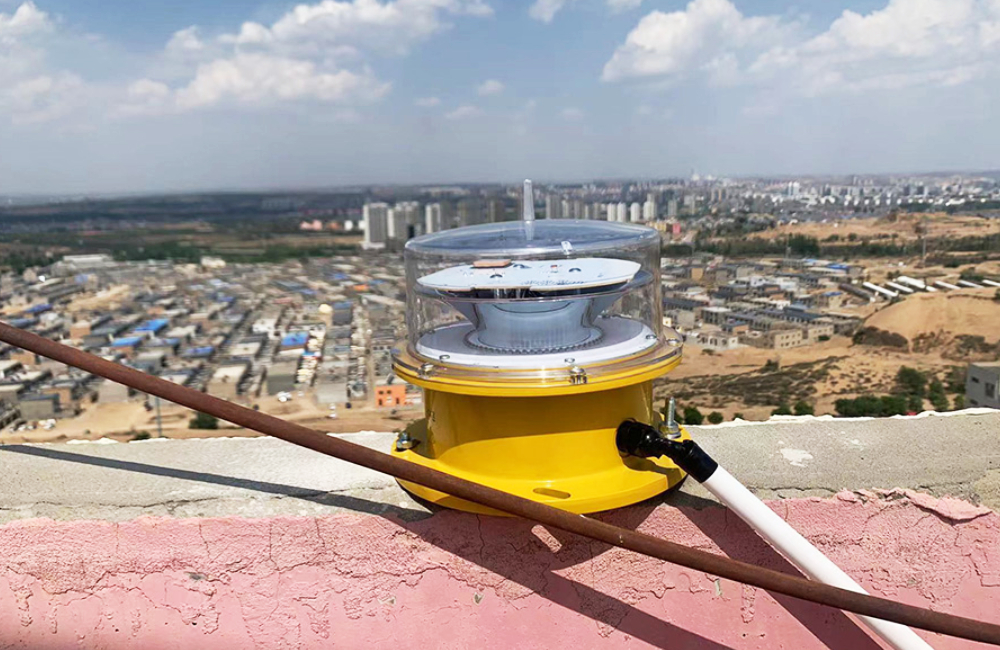
Choosing the correct aviation warning system is critical for structural compliance and airspace safety. Among various marking solutions, Type B medium-intensity aviation obstruction lights are widely mandated by international aviation authorities to warn pilots of tall structures during nighttime or low-visibility operations.
For procurement managers, civil engineers, and project contractors, selecting the right equipment involves navigating rigorous regulatory standards, engineering specifications, and lifecycle costs. This comprehensive guide breaks down everything you need to know to make an informed purchasing decision.
1. What Is a Type B Medium-Intensity Aviation Obstruction Lights?
Type B medium-intensity aviation obstruction lights are Day: 20,000cd; Twilight: 2,000cd; Night: 200cd, commonly used on structures approximately 45–150m AGL depending on regulations.
Unlike low-intensity Type C lights that operate only at night, Type B obstruction lights must remain active during all daylight and twilight hours. They alert pilots to tall structures — wind turbines, telecom masts, broadcast towers — that pose a collision hazard within controlled and uncontrolled airspace.
Core Technical Specifications:
| Parameter | Specification |
|---|---|
| Light color | White (daytime) |
| Peak intensity | 2,000 candela (cd) |
| Flash rate | 40–60 flashes per minute (fpm) |
| Flash duration | Minimum effective 0.05s |
| Beam elevation | +15° (Photometric distribution in accordance with ICAO Annex 14 requirements) |
| Azimuth coverage | 360° omnidirectional |
| Operating mode | Daytime & twilight continuous |
2. ICAO vs FAA Classification of Medium-Intensity Aviation Obstruction Lights
ICAO Annex 14 and FAA Advisory Circular 70/7460-1 share the Type B concept but differ in intensity thresholds, flash patterns, and national applicability — always verify with your local Civil Aviation Authority (CAA) before specifying equipment.
Both frameworks require medium-intensity white strobe lighting on structures exceeding height thresholds, but their technical requirements diverge in several areas.
ICAO Annex 14 (International Standard):
| Parameter | Requirement |
|---|---|
| Standard reference | Annex 14, Volume I |
| Type B peak intensity | 20,000cd(Day)、2,000cd(Twilight)、200cd(Night) |
| Flash rate | 20–60 fpm |
| Daytime color | White |
| Scope | International / global |
FAA AC 70/7460-1M (USA Domestic):
| Parameter | Requirement |
|---|---|
| Standard reference | AC 70/7460-1M |
| Equivalent designation | L-864 medium-intensity lights |
| Peak intensity | 2,000 cd |
| Flash rate | 40–60 fpm |
| Daytime color | White strobe |
| Scope | United States domestic |
Key difference: The FAA mandates automatic intensity control (dimming to 200 cd at night). ICAO recommends it but defers to national authorities. Always check local CAA amendments before purchasing.

3. Type A vs Type B vs Type C: Full Comparison
Type A (high-intensity light, 200,000 cd) is for the tallest structures;
Type B (medium intensity light, 2,000 cd) covers mid-height obstacles;
Type C (low intensity light, 10–200 cd) handles short structures requiring nighttime marking only.
| Feature | Type A (High) | Type B (Medium) | Type C (Low) |
|---|---|---|---|
| Peak intensity | 200,000 cd | 2,000 cd | 10–200 cd |
| Primary color | White / Red | White (day) | Red |
| Typical application range | > 105m AGL | 45–105m AGL | < 45m AGL |
| Operating period | Day + Night | Day + Twilight | Night only |
| Typical use | Tall towers, skyscrapers | Wind turbines, telecom masts | Rooftop equipment, cranes |
| Flash rate | 40–60 fpm | 40–60 fpm | Fixed or slow flash |
Type B medium-intensity aviation obstruction lights is the most widely deployed category globally, driven by the rapid expansion of wind energy infrastructure and 5G telecom towers in the 45–105 m height band.
4. Medium-Intensity Aviation Obstruction Lights: Height Requirements & Regulations
Any structure exceeding 45 m AGL in most jurisdictions requires medium-intensity obstruction lighting; exact thresholds vary by proximity to airports, airspace classification, and national regulation.
Global Height Trigger Thresholds:
| Authority | Height Trigger |
|---|---|
| ICAO (general) | ≥ 45 m AGL |
| FAA (USA) | ≥ 61 m (200 ft) AGL |
| EASA / EU | ≥ 45 m AGL (ED-2024/12) |
| China CAAC | ≥ 45 m AGL (MH/T 6012) |
| Near-airport zones | Lower thresholds may apply — consult local CAA |
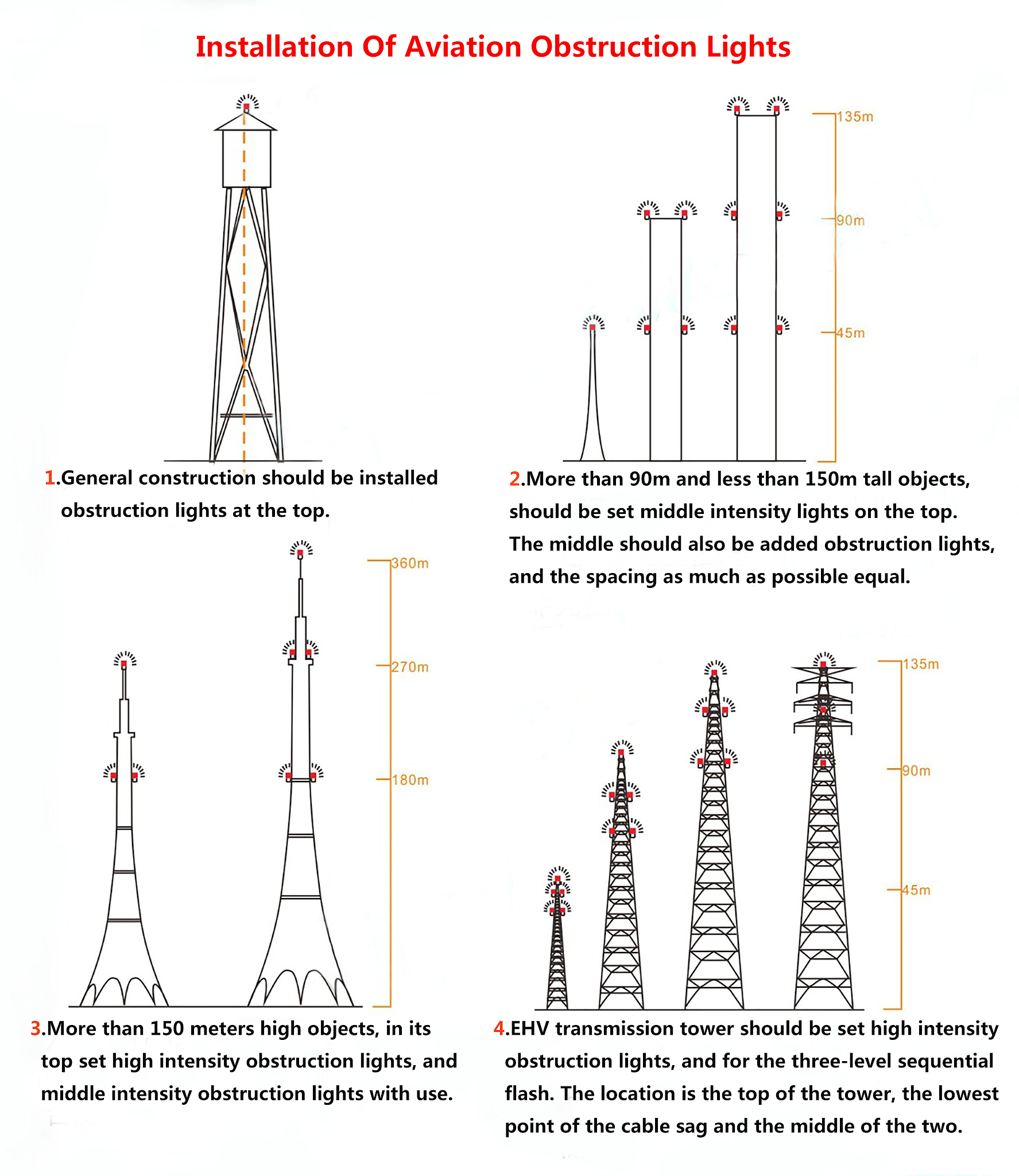
Vertical spacing rule: On structures taller than 105 m, Type B lights must be installed at every intermediate level at intervals not exceeding 45 m, in addition to the top-of-structure unit. A 150 m tower, for example, would require LED lights at approximately 50 m, 100 m, and 150 m.
5. Where Type B Medium-Intensity Aviation Obstruction Lights Are Used?
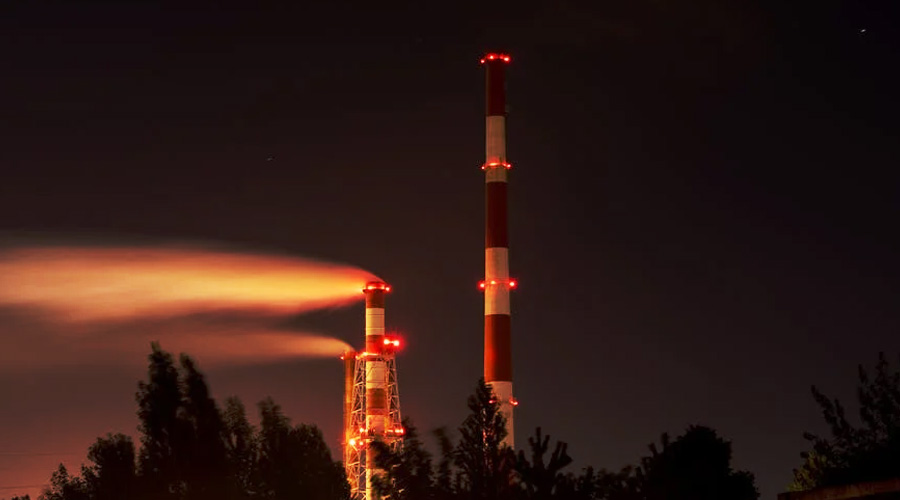
Wind turbines, telecom towers, broadcast masts, offshore platforms, and high-rise construction cranes are the five most common Type B application categories globally.
| Application | Notes |
|---|---|
| Wind energy turbines | Primary use; 60–150m hub height typical |
| Telecom / 5G masts | 50–120m typical height range |
| Broadcast towers | Often require dual Type A + Type B combination |
| Offshore oil & gas platforms | Marine-rated IP66/67 enclosures required |
| Construction cranes | Temporary aviation permit required in most countries |
| High-rise buildings | Architectural integration solutions available |
| Power line towers | Catenary-specific spacing rules apply |
Offshore and coastal installations require special attention to enclosure ratings, corrosion resistance, and salt-fog certification (IEC 60068-2-52) to ensure long-term reliability.
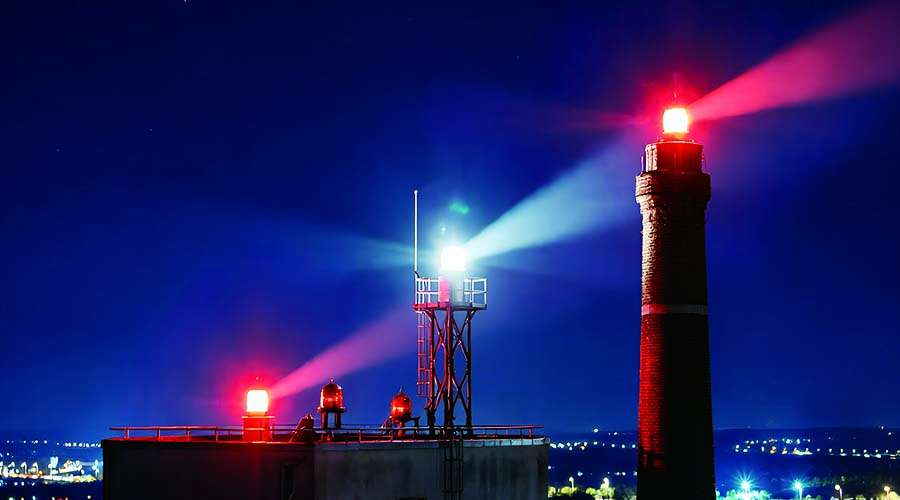
6. Solar vs AC-Powered Systems Aviation Obstruction Lights
Type B Solar-powered aviation light systems are viable for remote sites with ≥ 4 peak sun hours per day; AC-powered systems remain the preferred choice for reliability in cloudy climates or high-density multi-light arrays.
| Factor | Solar Off-Grid | AC + UPS Backup | Solar + AC Hybrid |
|---|---|---|---|
| Upfront cost | Higher | Lower | Highest |
| Running cost | Near zero | Grid electricity | Low |
| Reliability | Weather-dependent | Highest | Very high |
| Best suited for | Remote towers | Urban / coastal sites | Critical infrastructure |
| Maintenance | Battery replacement every 3–5 years | UPS battery check annually | Both apply |
Battery sizing rule of thumb: A 2,000cd LED Type B unit consumes approximately 30–50 W at peak. Size the battery bank for a minimum of 5 consecutive cloudy days of autonomy — typically ≥ 120 Ah at 24 V DC for most standard installations.
7. Single vs Twin Obstruction Warning Lights
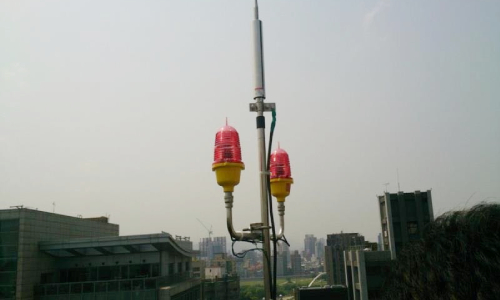
Twin-light configurations provide the mandatory redundancy required by most CAAs on critical-height structures; single-light installations are only acceptable where maintenance response time is guaranteed within 24 hours.
| Factor | Single Light | Twin Light (Redundant) |
|---|---|---|
| Upfront cost | Lower | +40–60% |
| Redundancy | None | Auto-failover |
| Maintenance SLA required | ≤ 24 hours | Flexible |
| Regulatory acceptance | Limited (low-risk only) | Broad acceptance |
| Best suited for | Low-risk, accessible structures | Wind farms, tall masts, offshore |
Mounting rule: When Type B Medium-Intensity Aviation Obstruction Lights – twin lights are installed, mount them on opposing sides of the structure — 180° apart — to maintain full 360° azimuth visibility even when one unit fails. This is a common point of inspection during CAA compliance audits.
8. GPS Synchronization Explained
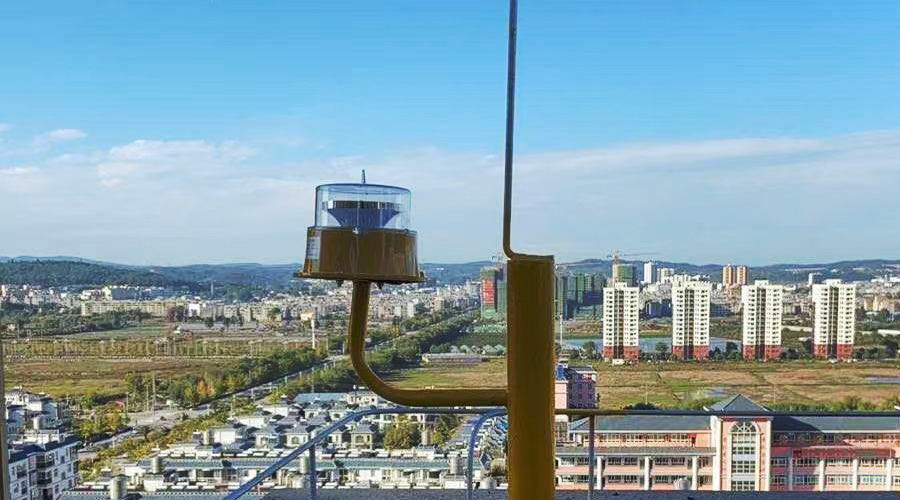
GPS synchronization ensures all aviation obstacle lights across a wind farm or multi-tower site flash simultaneously, dramatically reducing pilot visual fatigue and improving hazard recognition at a distance.
Without synchronization, dozens of asynchronous flashing lights create visual noise that makes it harder — not easier — for pilots to identify the boundary of an obstacle field. GPS sync solves this.
GPS Sync Technical Specifications:
| Parameter | Specification |
|---|---|
| Synchronization accuracy | ≤ ± 10 ms between units |
| Signal source | GPS L1 band (1575.42 MHz) |
| Fallback mode | Internal oscillator (free-run) |
| Maximum units per farm | Unlimited (each unit self-syncing) |
| Required by | Germany, Denmark, Netherlands wind regulations |
| Primary benefit | Reduced pilot fatigue; meets NfL/LuftVG requirements |
Demand-based lighting (ADL): Advanced GPS-sync systems can integrate with aircraft detection radar or ADS-B transponder receivers to activate lights only when an aircraft enters a defined radius. This approach reduces unnecessary nighttime light exposure typically 70–95%, up to 97% in some projects, while maintaining full regulatory compliance.
9. Fault Monitoring & Remote Alarm Systems
Aviation regulators require prompt notification of any lighting failure; modern Type B systems use SCADA, GSM/4G, or RS-485 Modbus communication to deliver fault alerts to operators within seconds.
Under FAA regulations, a NOTAM (Notice to Air Missions) must be filed within 30 minutes of discovering a lighting failure. Automated monitoring makes this response time achievable in practice.
Fault Alert Communication Options:
| Method | Latency | Best Use Case |
|---|---|---|
| GSM / 4G SMS alert | < 30 seconds | Remote sites without wired infrastructure |
| Modbus RS-485 | < 1 second | SCADA integration on industrial sites |
| SNMP / Ethernet | < 1 second | Enterprise NMS / IT-managed networks |
| Dry contact relay | Immediate | Legacy alarm panel integration |
Monitored parameters typically include: LED driver current, lamp output voltage, ambient light sensor status, GPS lock confirmation, battery voltage (solar systems), enclosure temperature, and door-open tamper detection.
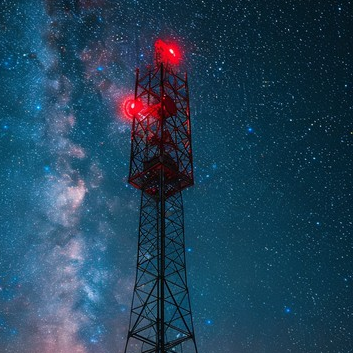
10. Medium-Intensity Aviation Obstruction Lights – Installation Design Examples
A standard 80m wind turbine installation uses one top-mounted GPS-sync Type B unit paired with a red low-intensity Type C unit for nighttime mode — achieving full ICAO Annex 14 compliance with a single combined controller.
Example A — 80m Wind Turbine:
| Element | Specification |
|---|---|
| Top light | Type B Medium-Intensity Aviation Obstruction Lights (2,000 cd white strobe) |
| Night mode | Type C red fixed (200 cd) |
| Synchronization | GPS synchronized across wind farm |
| Power supply | AC 230 V with 8-hour UPS backup |
| Monitoring | 4G remote alarm + SCADA Modbus |
Example B — 95m Telecom Mast:
| Element | Specification |
|---|---|
| Top lights | Twin Type B units (180° apart) |
| Intermediate (50 m) | Type B intermediate lights |
| Night mode | Auto-dim to 200 cd red |
| Power supply | AC + solar hybrid |
| Monitoring | SMS fault alert + dry contact alarm |
For structures with multiple light levels, a centralized lighting controller (CLC) is recommended to manage flash synchronization, mode switching, and fault reporting from a single device.
11. Common Compliance Mistakes
The three most frequently cited compliance failures are: specifying the wrong light type, omitting intermediate lights on tall structures, and failing to file a NOTAM promptly after a lamp outage.
Critical errors (regulatory violation risk):
- Wrong light type: Installing low-intensity Type C on a 60m structure that mandates Type B. This is the single most common specification error.
- Missing intermediate lights: Installing only a top light on structures taller than 105 m without required 45 m interval units.
- NOTAM failure: Not notifying aviation authorities within the mandated window (30 minutes under FAA rules) after a lighting failure is discovered.
Common technical mistakes (performance risk):
- Obstructed coverage: Mounting the light behind antenna arrays, guy wires, or structural members that block portions of the 360° azimuth arc.
- Incorrect flash rate: Using a flash controller set outside the 40–60 fpm required range — a common issue when replacing Xenon strobes with LED units using incompatible controllers.
- No intensity control: Running full 2,000 cd output at night, violating light pollution ordinances in many jurisdictions.
- Inadequate IP rating: Deploying IP54-rated enclosures in coastal or offshore environments that require IP66 minimum.
12. Buyer’s Checklist
Before purchasing any Type B medium-intensity aviation obstruction lights unit, confirm it appears on your national CAA’s approved equipment list — CE marking or FCC approval alone does not guarantee acceptance by every aviation authority.
Use this checklist to evaluate suppliers and specifications:
Regulatory compliance:
- [ ] Meets ICAO Annex 14 / FAA TSO-C119 / local CAA-approved equipment list
- [ ] Third-party photometric test report available (not just manufacturer’s claim)
- [ ] Country of installation regulatory approval confirmed in writing
Performance specifications:
- [ ] Peak intensity: 2,000 cd ± 25% at rated voltage
- [ ] Flash rate: 40–60 fpm with < 5% variance across operating temperature range
- [ ] 360° azimuth coverage with no shadow zones exceeding 5°
- [ ] Beam elevation: covers ≥ +15° above horizontal
Durability & environment:
- [ ] IP rating: minimum IP65 terrestrial; IP66/67 for coastal or marine
- [ ] Operating temperature range: −40°C to +70°C (verify for extreme climates)
- [ ] Salt-fog certification for offshore: IEC 60068-2-52
Lifetime & reliability:
- [ ] LED rated lifetime: ≥ 100,000 hours at L70 lumen maintenance
- [ ] MTBF (mean time between failures): ≥ 50,000 hours
- [ ] Auto-dimming: built-in photocell for day/twilight/night mode switching
Features & integration:
- [ ] GPS sync: 1PPS input or integrated GPS receiver
- [ ] Remote monitoring: RS-485 Modbus, 4G/GSM, or dry contact alarm output
- [ ] Automatic intensity control: 2,000 cd day / 200 cd night
Commercial terms:
- [ ] Warranty: minimum 3 years on LED assembly; 2 years on control electronics
- [ ] In-country spare parts and maintenance support confirmed
- [ ] Factory acceptance test (FAT) report available on request

Looking for high-quality medium-intensity aviation obstruction lights for sale? Contact our project engineering support team today.
13. FAQ
Q1: How long do Type B medium-intensity aviation obstruction lights last?
Modern LED Type B light units are rated for ≥ 100,000 hours at L70 lumen maintenance — approximately 11 years of continuous 24/7 operation before brightness falls below 70% of the original output value. Xenon strobe predecessors typically lasted 1,000–3,000 hours.
Q2: Can one Type B aircraft warning light cover an entire wind farm?
No. Each turbine exceeding the applicable height threshold requires its own independently compliant light. GPS synchronization makes all units flash simultaneously, improving pilot recognition — but it does not allow one light to substitute for another.
Q3: What is the difference between “Type B” and “L-864”?
Type B is an ICAO medium-intensity obstruction light classification, while L-864 is an FAA designation for a medium-intensity red flashing obstruction light.
They serve similar aviation warning functions but follow different standards and specifications. Always verify local regulatory requirements before selecting an obstruction lighting system.
Q4: Do Type B aviation lights need to operate during the day?
Yes — this is their defining characteristic. Type B obstruction warning lights are designed and required to operate continuously during daylight and twilight hours.
Type C (low-intensity red) is the night-only complement that is often used alongside Type B in combined systems.
Q5: How quickly must a light failure be reported?
Under FAA regulations, a NOTAM must be filed within 30 minutes of discovering a lighting failure. ICAO-member states vary, but 30–60 minutes is the standard in most countries. Automated fault monitoring and alarm systems are strongly recommended to meet this requirement reliably.
Q6: Is aircraft detection (demand-based lighting) required?
Not yet globally mandatory, but it is being progressively required or strongly incentivized for wind farms in Germany, the United Kingdom, and parts of Scandinavia.
Demand-based lighting systems activate only when an aircraft is within a defined radius, reducing unnecessary nighttime light exposure by up to 97% while maintaining full safety compliance.
Q7: Can LED Type B lights replace older Xenon strobe units without rewiring?
In most cases, yes. LED Type B units are designed to be drop-in compatible with existing mounting hardware and AC wiring. However, always verify photocell compatibility and flash controller settings — some legacy controllers are not compatible with LED driver requirements and must be replaced separately.
Last reviewed: 2025 | Regulatory references: ICAO Annex 14 (10th Ed.), FAA AC 70/7460-1M, EASA ED Decision 2024/012/R