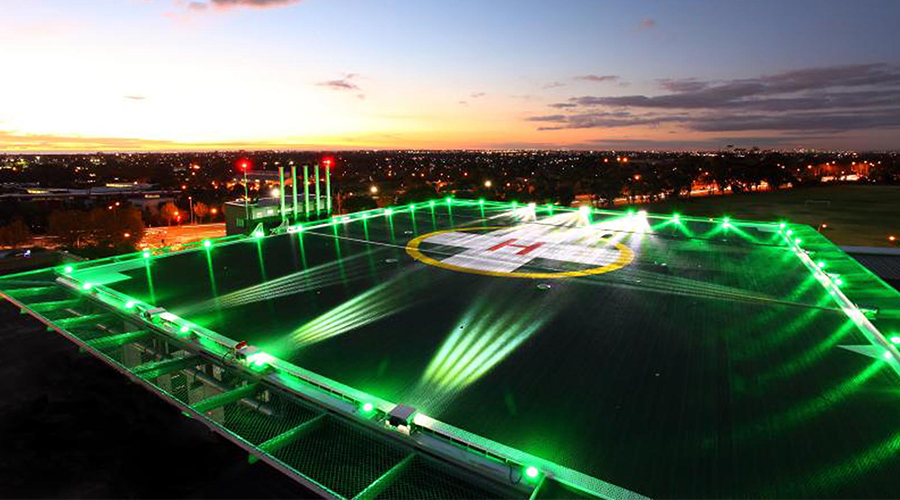
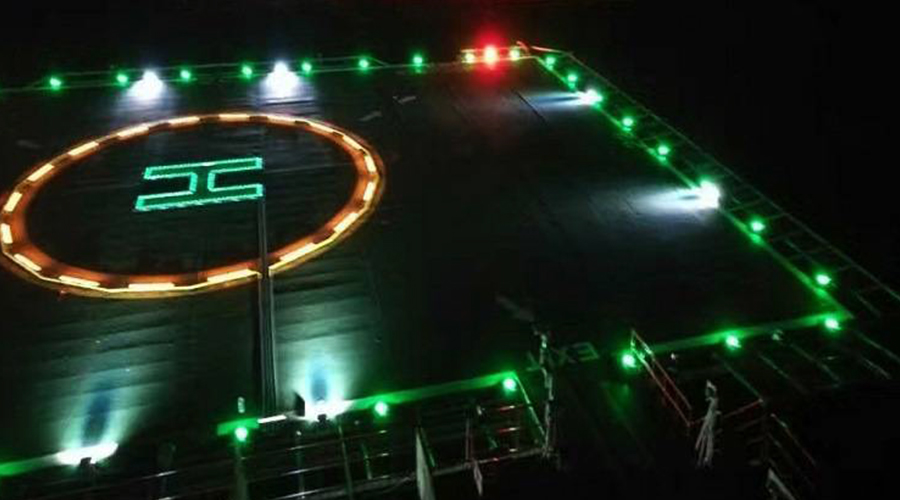
Heliport elevated perimeter light is primarily used to mark the boundaries of heliports and ensure flight safety. These helipad lights typically utilize LED light sources, providing high-brightness, energy-efficient illumination.
Depending on the application scenario, elevated boundary lights may be green, yellow, white, red, blue, or infrared.
The layout and number of elevated boundary lights depend on the type and size of the heliport. For example, elevated heliport boundary lights should be spaced no more than 3m apart, requiring at least 4 lights per side.
To reduce glare, some lights are equipped with shutters. This design helps reduce operating costs and improve efficiency.
Key Features of Heliport Elevated Perimeter Light
1. Accurate Positioning & Warning Function
Core Function:
Clearly mark the physical boundaries of the helipad, providing pilots with a clear visual reference, especially at night, in fog, haze, or in complex weather conditions, to avoid landing inadvertently or straying from hazardous areas.
Compliance:
Strictly adheres to the standards of the International Civil Aviation Organization (ICAO), the Federal Aviation Administration, and various national aviation authorities for obstacle lighting and visual aids.
Light Characteristics:
Utilizing directional lighting technology, the beam angle is optimized to ensure optimal coverage of the effective field of view while minimizing glare for pilots.
2. Adaptability to Harsh Environments
Weather Resistance: The outer shell of heliport elevated perimeter light is typically constructed from high-strength aluminum alloy and PC, offering excellent resistance to UV aging, corrosion, and salt spray testing (passing salt spray testing standards), and can withstand extreme temperature fluctuations (-40°C to +70°C).
Protection Rating: Typically reaching IP67/IP68, the lights are fully sealed against water and dust, ensuring stable operation in heavy rain and snow.
Seismic Design: Reinforced to withstand the vibration and impact of helicopter takeoffs and landings, ensuring long-term stability.
3. Energy Efficiency & Long Life
Light Source Technology: airport boundary lights utilize LEDs, which consume over 80% less energy than traditional halogen lamps and offer a lifespan of over 50,000 hours, significantly reducing maintenance frequency and costs.
Intelligent Control: Supports light-controlled and time-controlled automatic opening and closing (solar airport light series). Select models can be connected to the airport’s unified monitoring system for remote status monitoring.
4. Professional Structural Design
Adjustable Height: The bracket system allows customization of the LED warning light’s height to suit the takeoff and landing specifications of different aircraft models.
Modular Installation: Multiple mounting options, including flanges and clamps, allow for flexible integration with concrete foundations, metal railings, and other infrastructure.
Color Coding: Configured in a red/white color combination according to international standards, red is used for obstacle warnings, and white delineates active areas. Custom colors are also available upon request.
Recommended Apron Warning Lights
Advantages of Installing the YFFY-HP-E2 Airport Heliport Elevated Perimeter Light
- The integrated elevated structure simplifies deployment.
- This airport lights integrates the luminaire and support pole into a single unit, eliminating the need for complex on-site bracket assembly. After transport to the aircraft stand, it can be directly secured with pre-buried flanges, shortening the installation period.
- For new temporary landing and take-off points or emergency repairs, installation and commissioning can be completed quickly.
- The bracket is wrapped with a flexible sheath to reduce the risk of equipment damage in the event of a collision.
- Multiple apron lights can be connected in series via a custom bus, enabling GPS-synchronized flashing frequency adjustment or independent zone control, meeting the complex scheduling requirements of large hub airports.
Installation Case
Airport elevated perimeter lights not only meet the essential safety requirements of civil aviation, but also significantly improve installation efficiency and ease of operation and maintenance.
They are particularly recommended for the following scenarios:
▸ Rooftop aprons on urban high-rise buildings (for space-constrained scenarios)
▸ Temporary landing and take-off points on offshore oil platforms (for environments with high salt spray corrosion)
▸ General aviation airport expansion projects (requiring rapid deployment)