Chimney Aviation Light: The Installation Standards and Significance – What We Should Know?
TABLE OF CONTENTS
- Aviation Obstruction Lights and Markings for Chimneys
- I. Why Must Chimneys Be Equipped with Aviation Obstruction Lights?
- II. Do All Chimneys Need Aviation Obstruction Lights?
- III. General Requirements for Chimney Obstruction Lighting
- IV. Types of Aviation Obstruction Lights and Markings for Chimneys
- V. What Type of Aviation Obstruction Light Should Be Installed on a Chimney?
- VI. Distribution and Quantity of Aviation Obstruction Lights on Chimneys
- VII. Operating Requirements for Chimney Aviation Light
- VIII. Installation Effect Reference
- IX. Advantages of Employing Aviation Lights on Chimneys
- X. Chimney Aviation Light Product Recommendation
- Reference
Aviation Obstruction Lights and Markings for Chimneys
I. Why Must Chimneys Be Equipped with Aviation Obstruction Lights?
Chimneys (Chimney / Industrial Stack) are among the most common tall structures in industrial facilities, widely found in power plants, chemical plants, cement plants, metallurgical factories, paper mills, and large manufacturing complexes. Their heights typically range from 45 meters to over 200 meters, and in some cases much higher.
Due to their height, slender shape, emission characteristics, and placement within industrial zones, chimneys pose significant potential threats to aviation safety. Therefore, international and national civil aviation regulations clearly mandate that chimneys must be equipped with aviation obstruction lights.
In aviation safety, chimneys are classified as high-risk obstructions. ICAO, FAA, and China’s Civil Aviation Authority all list chimneys as structures that require priority marking and mandatory obstruction lighting. Their high-risk nature results from multiple aviation hazards overlapping, rather than a single factor.

II. Do All Chimneys Need Aviation Obstruction Lights?
Whether aviation obstruction lighting is required depends on whether the chimney poses a potential hazard to aircraft operations. Aircraft include not only civil airplanes, but also military aircraft and helicopters. If a chimney is located outside active flight corridors or areas where aircraft operate, the requirement may not be mandatory.
However, according to international regulations, chimneys above specific heights must be marked with aviation obstruction lights.
1. ICAO Requirements
ICAO Annex 14 states:
- All fixed structures exceeding 45 meters in height must be marked with aviation obstruction markings or lights.
- Chimneys, due to their slender shape and low visibility, typically require:
- Medium-intensity red flashing lights (for nighttime)
- Medium-intensity white flashing lights (for daytime)
- Chimneys over 105 meters must have multiple tiers of obstruction lights.
2. FAA (United States) Requirements
FAA AC 70/7460-1L includes specific provisions for chimneys:
- The top of the structure must be equipped with medium- or high-intensity obstruction lights.
- Chimneys exceeding 61 meters (200 ft) require obstruction lighting.
- For groups of chimneys (“Group of Stacks”), lights must be placed to mark the overall outer perimeter.
3. Civil Aviation Administration of China (CAAC)
According to CCAR-139 and MH/T 6012:
- Structures over 45 meters must be fitted with obstruction lights.
- Industrial facilities (chimneys, stacks, cooling towers, etc.) are mandatory marking targets.
- Lights must meet requirements regarding light intensity, color, mounting height, and flash frequency.
Conclusion:
Installing aviation obstruction lights on chimneys is not optional — it is a legal requirement.
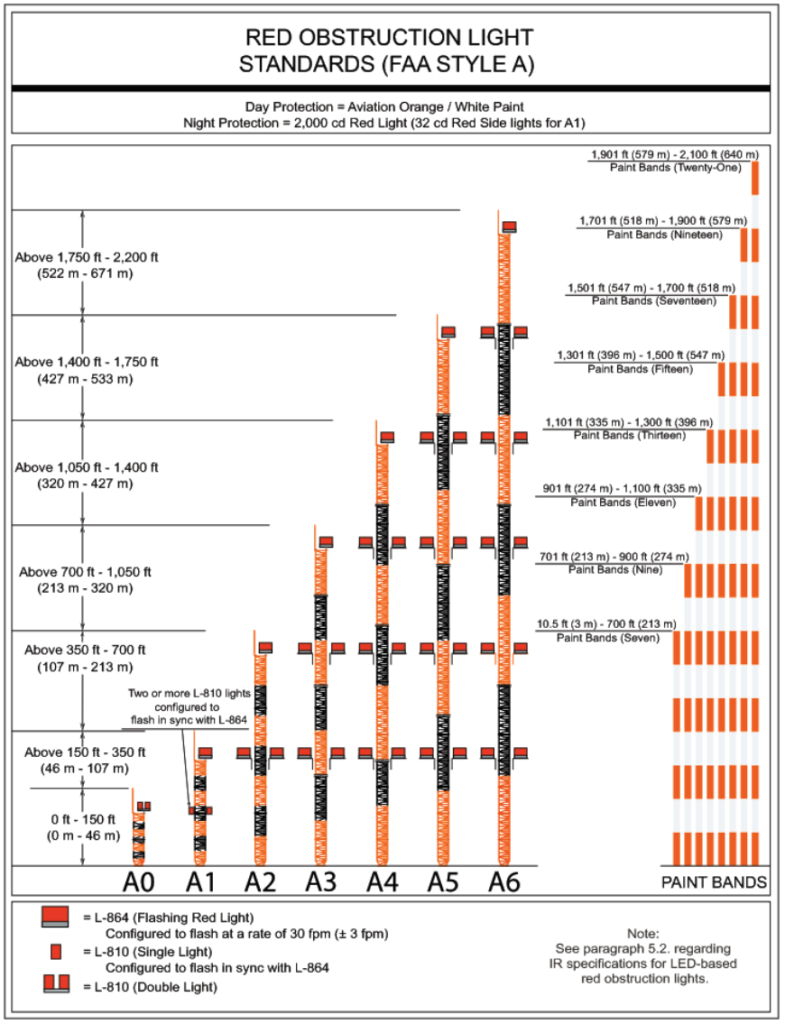
Figure 1. Red Obstruction Light Standards. Sourced from ‘FAA AC 70/7460-1L Obstruction Marking and Lighting‘ by FAA Airspace Service AJV-15 2018, Obstruction Marking and Lighting, AC 70/7460-1L, p. A-7. Copyright 2018 by FAA Airspace Service (AJV-15).
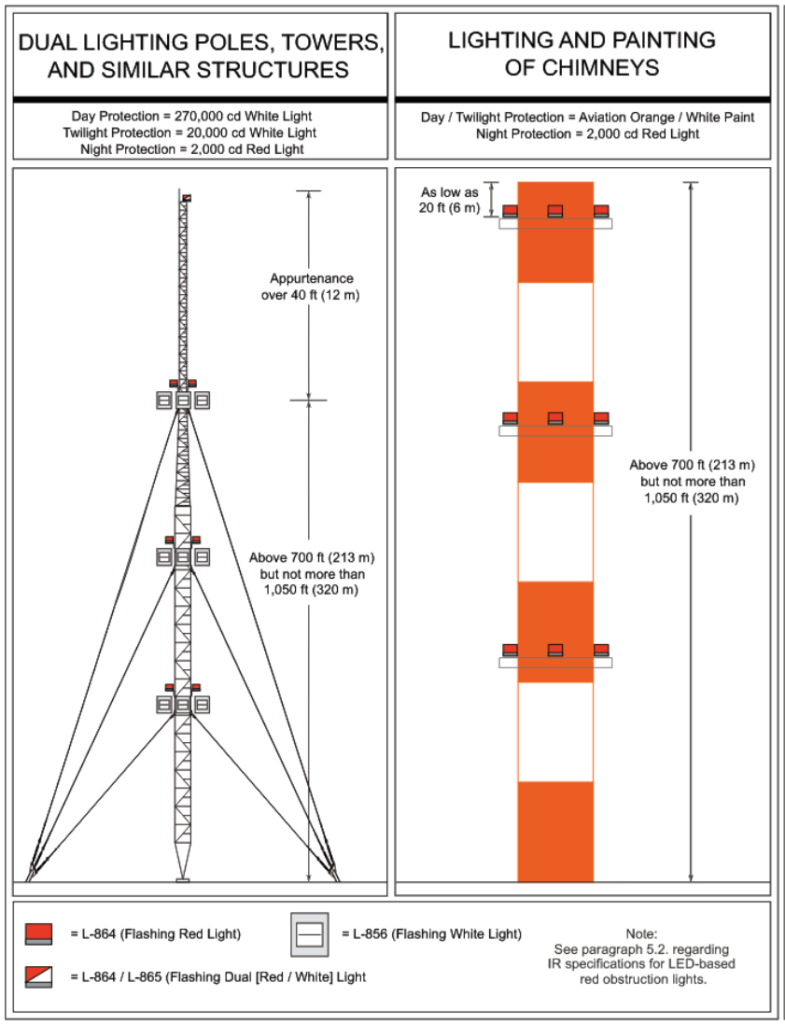
Figure 2. Painting and/or Dual Lighting of Chimneys, Poles, Towers, and Similar Structures. Sourced from ‘FAA AC 70/7460-1L Obstruction Marking and Lighting‘ by FAA Airspace Service AJV-15 2018, Obstruction Marking and Lighting, AC 70/7460-1L, p. A-14. Copyright 2018 by FAA Airspace Service (AJV-15).
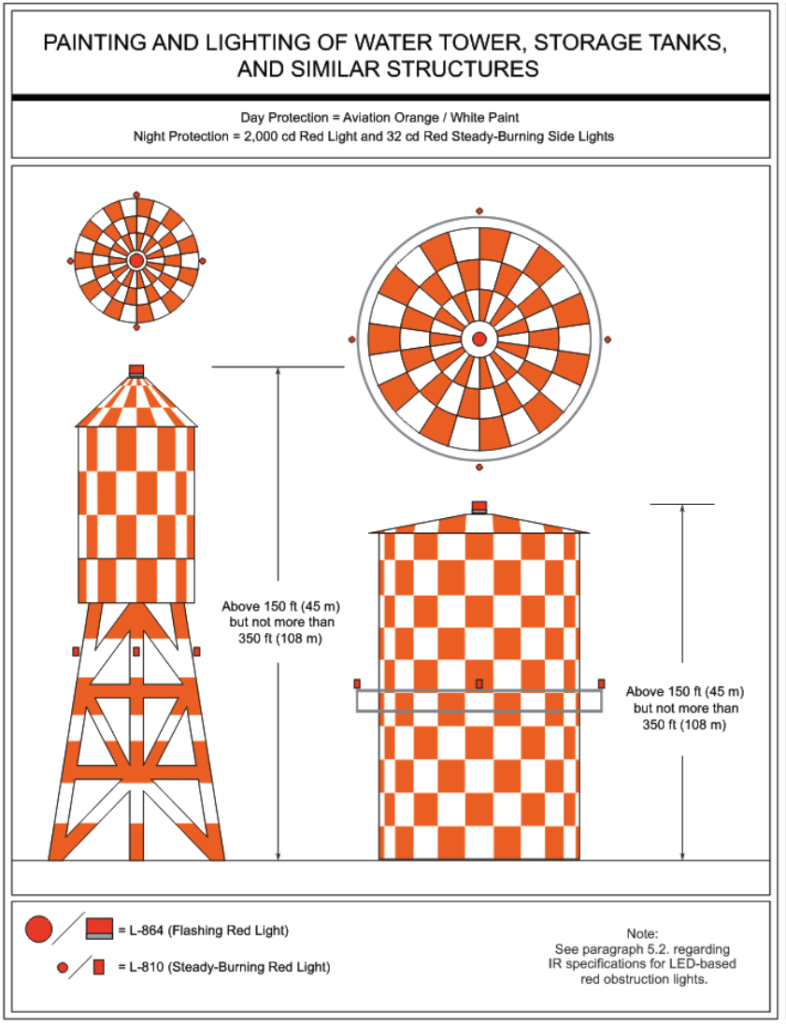
Figure 3. Painting and Lighting of Water Towers, Storage Tanks, and Similar Structures. Sourced from ‘FAA AC 70/7460-1L Obstruction Marking and Lighting‘ by FAA Airspace Service AJV-15 2018, Obstruction Marking and Lighting, AC 70/7460-1L, p. A-18. Copyright 2018 by FAA Airspace Service (AJV-15).
III. General Requirements for Chimney Obstruction Lighting
The following chimney types must be equipped with chimney aviation light and markings when they pose a potential threat to aircraft:
- Chimneys exceeding 150 meters in height.
- Chimneys within airport obstacle limitation surfaces (typically within a 50 km radius), exceeding 45 meters.
- Chimneys exceeding 45 meters are located under aircraft flight routes.
- Chimneys located within urban areas that have elevated helipads or helicopter operations.
IV. Types of Aviation Obstruction Lights and Markings for Chimneys
1. Medium-Intensity Type B Red Flashing Lights
- Must operate at night.
- Flash rate: 20–60 flashes per minute.
- Effective intensity: not less than 1600 cd.
2. High-Intensity Type A White Flashing Lights
- Operate day and night.
- Flash rate: 40 flashes per minute.
- Effective intensity varies with background brightness:
- Daytime: 200,000 cd
- Twilight (dawn/dusk): 20,000 cd
- Night: 2000 cd
3. Chimney Aviation Light Color Marking (Paint Bands)
- Alternating orange/white or red/white horizontal bands.
- Bands perpendicular to the chimney’s vertical axis.
- Band width should be the lesser of:
- 1/7 of the chimney height, or
- 30 meters
- The number of bands should be odd, with the top and bottom bands using the darker color.
V. What Type of Aviation Obstruction Light Should Be Installed on a Chimney?
- Aviation obstruction lights are categorized as low-, medium-, and high-intensity. The required type depends primarily on chimney height.
The threshold of 45 meters is a key reference. - Chimneys ≤ 45 meters
- Only one layer of low-intensity obstruction lights at the top is required.
- Chimneys > 45 meters
- Multiple layers of medium-intensity lights must be installed.
- Vertical spacing: ≤ 45 meters, and spacing should be as uniform as possible.
- Chimneys > 150 meters
- High-intensity Type A lights may be used.
- Vertical spacing: 75–105 meters.
- Low- or medium-intensity lights should be used between high-intensity tiers.
- Chimneys < 150 meters may also use high-intensity Type A lights
- If high-intensity Type A lighting is used, color markings (paint bands) are not required.
VI. Distribution and Quantity of Aviation Obstruction Lights on Chimneys
- Obstruction lights must mark the highest point and outermost perimeter of the chimney.
- Chimneys exceeding 45 meters must include intermediate tiers of lights.
- Intermediate tiers: vertical spacing must not exceed 45 meters, and should be uniform.
- Top-tier obstruction lights must be installed 1.5–3 meters below the top of the chimney.
- For chimneys over 150 meters, lights may be installed 4–6 meters below the top opening.
Number of Lights per Tier (Based on External Diameter)
- Diameter ≤ 6 meters → 3 lights per tier
- Diameter ≤ 30 meters → 4 lights per tier
- Diameter ≤ 60 meters → 6 lights per tier
High Chimneys (>150 m)
- Top tier: High-intensity Type A lights.
- Middle tiers: High-intensity Type A lights spaced 75–105 meters apart.
- Remaining tiers: Medium-intensity red or white lights.
Maintenance Requirements
- Each tier should be equipped with a maintenance platform for servicing the obstruction lights.
VII. Operating Requirements for Chimney Aviation Light
- All lights installed on the chimney must flash synchronously.
- High-intensity lights must be capable of automatic intensity adjustment.
- Medium-intensity lights must turn on/off automatically based on ambient light.
- All lights must be capable of automatic monitoring to ensure proper operation.
For chimneys below 150 meters, since painted markings may have limited warning effectiveness, high-intensity Type A white flashing lights may be used instead. When Type A lights are used, paint markings are no longer required.
Such lights should be installed at not less than 75 meters, and preferably around 90 meters above ground.
VIII. Installation Effect Reference
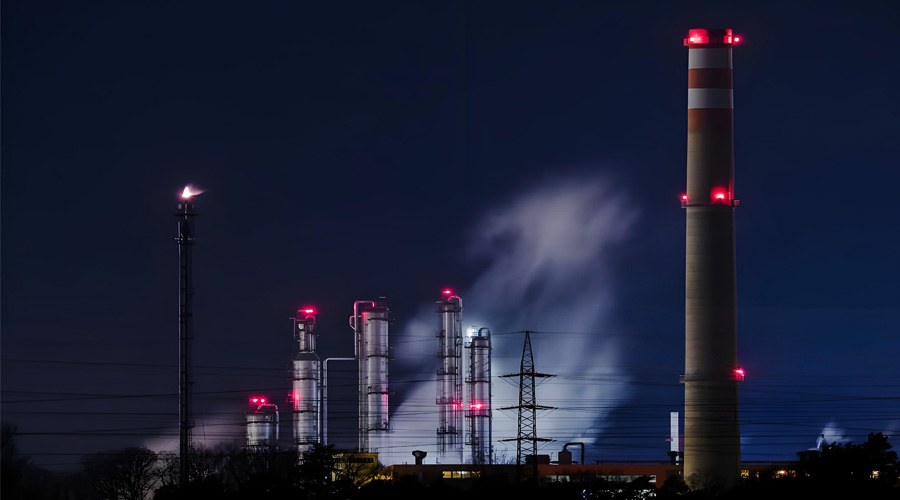
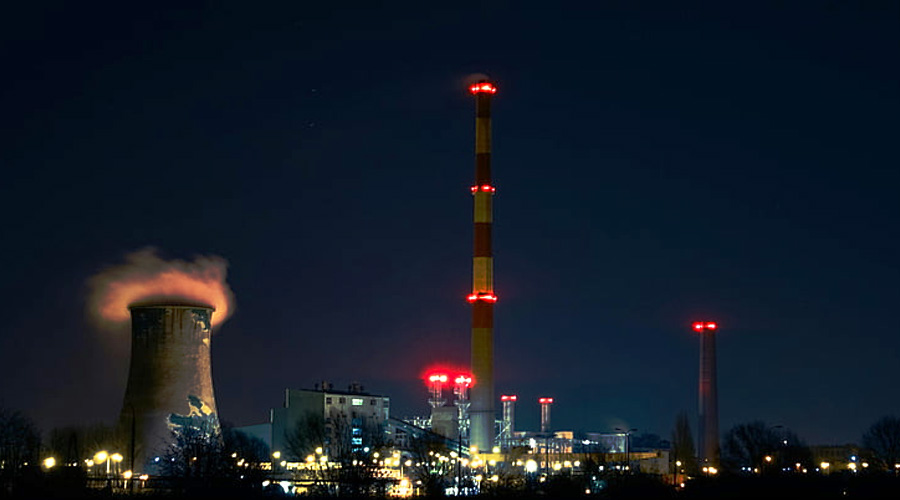
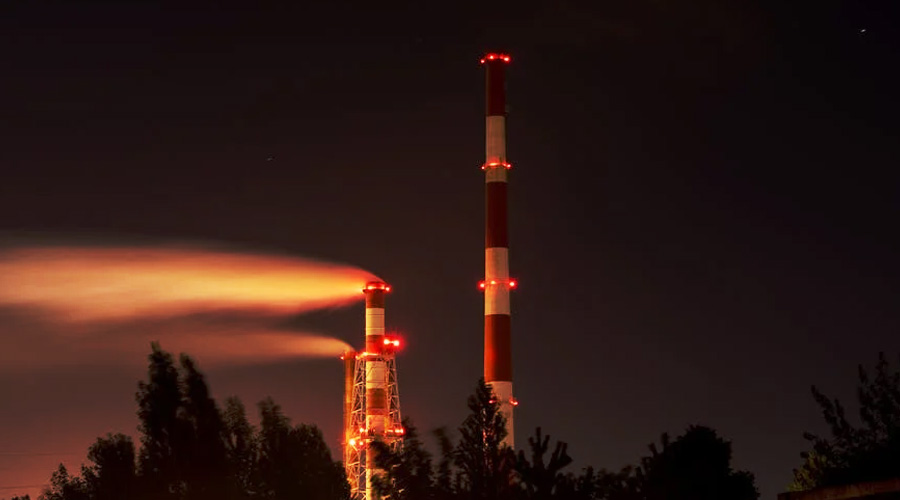
IX. Advantages of Employing Aviation Lights on Chimneys
X. Chimney Aviation Light Product Recommendation
Reference
FAA Airport Engineering Division (AAS-100), 202-267-7669 2019, AC 150/5345-43J, Specification for Obstruction Lighting Equipment, 3/11/2019 (errata updates 4/29/2019), AAS-100, Office of Airport Safety & Standards – Airport Engineering Division, Washington, DC 20591, viewed 24 October 2020, < https://www.faa.gov/documentLibrary/media/Advisory_Circular/150-5345-43J.pdf>.
FAA Airspace Service (AJV-15) 2018, AC 70/7460-1L, Obstruction Marking and Lighting, FAA Airspace Service (AJV-15), Washington, DC 20591, viewed 24 October 2020, < https://www.faa.gov/documentLibrary/media/Advisory_Circular/AC_70_7460-1L_-_Obstuction_Marking_and_Lighting_-_Change_2.pdf>.