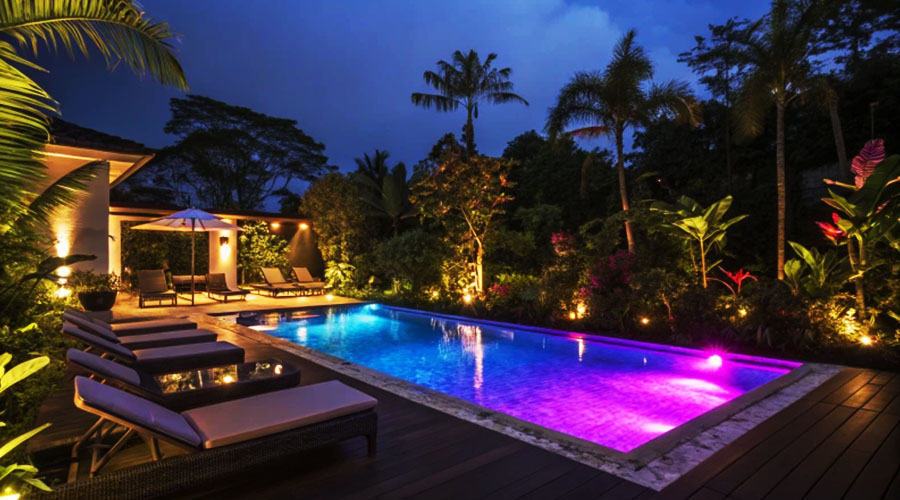

In swimming pool lights applications, since these are classified as “electrical devices for special locations,” the primary principle is protection against electric shock. Ordinary underwater lights must never be used in underwater environments.
Professional pool lights must meet the following three ironclad rules: protection level; voltage safety; and installation specifications. Any installation scheme must strictly adhere to national standards and lighting fixture manufacturing standards.
I. Swimming Pool Lights: Professional Installation Standards
1. Voltage Level Limitation (SELV) [1]
Standards stipulate:
- Zone 0 (inside the water): Extra Low Voltage (SELV) pool light must be used, with AC not exceeding 12V AC and DC not exceeding 30V DC.
- Zone 1 (inner surface of the pool wall and within 2 meters of the edge): A 12V/24V low-voltage system is also recommended.
If 220V/110V high-voltage lighting fixtures must be used, a residual current device (RCD/GFCI) with a rated residual operating current not exceeding 30mA must be provided, and the pool light must have double insulation or reinforced insulation (currently, high-voltage water inlet schemes have been completely phased out in mainstream high-end projects).
Professional Advice:
The transformer must be installed in a dry distribution box outside the pool area. It is strictly forbidden to place it in maintenance pits or damp environments near the pool.
The primary side (220V) and secondary side (12V) of the transformer must be electrically isolated.
2. Protection Rating (IP Rating)
Standard Specification:
Underwater LED lights that are submerged in water must have an IP68 protection rating.
Note: IP67 only indicates short-term immersion (typically 30 minutes at a depth of 1 meter). Its strictly prohibited for use in pool lights intended for long-term underwater operation.
Recommendation:
When purchasing, ensure the manufacturer has an IP68 immersion test report (usually requiring continuous operation at a depth of 1.5-3 meters for over 48 hours without leakage). e.g. YFFY underwater pool lights undergo at least 48 hours of point aging and underwater testing before leaving the factory.
For pool water containing chemicals such as chlorine and bromine, the sealing materials for the pool lights (such as silicone rings) must be chemically resistant.
For certain marine-grade or high-corrosion-resistance applications (such as seawater swimming pools and hot springs), professional-grade products with 316L stainless steel housings (e.g., some marine-grade or high-power industrial-grade underwater light series) can be selected to cope with more severe corrosive environments.
3. Grounding & Equipotential Bonding
Standards Stipulate
All metal components ( swimming pool lights housing, stainless steel panel, embedded parts, and metal pipes within the pool) must be locally equipotentially bonded (LEB).
Even when using 12V low-voltage underwater swimming pool lights, their metal housings must be grounded to prevent high-voltage side faults from being conducted to the low-voltage side or generating induced electricity.
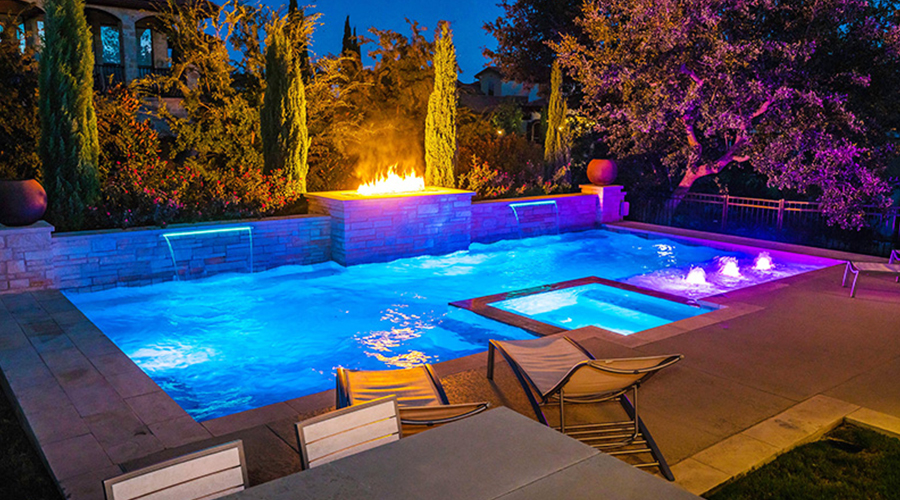
II. Pool Light Layout Standards
Proper lighting layout is not only for illumination but also for eliminating glare, avoiding shadow areas (safety hazards), and creating ambiance.
1. Installation Position & Depth
Vertical Height:
The center distance of the swimming pool underwater light from the normal water surface is recommended to be between 45cm and 60cm.
- Too shallow: Direct light into the eyes causes glare, and water surface fluctuations cause severe flickering of the light spot.
- Excessive depth: Light is absorbed and attenuated by the water, resulting in insufficient illumination at the pool bottom and hindering maintenance.
Horizontal Spacing:
- A spacing of 3-5 meters is generally recommended (depending on the underwater light’s power and beam angle).
- For rectangular pools, swimming pool lights should be evenly distributed along the long side; for irregularly shaped pools, ensure there are no blind spots.
- Special applications: When specific areas need focused illumination (such as under diving platforms or steps), additional spotlights can be added. For large bodies of water or scenarios requiring long-distance projection, high-power floodlights with narrow beam angles can be selected.
2. Color temperature & color rendering index
Color temperature selection:
- 3000K (Warm White): Creates a warm, resort-like atmosphere, suitable for private pools and spa pools.
- 4000K-5000K (Natural White/Cool White): Simulates sunlight, providing high clarity, suitable for competition pools, training pools, and public pools.
- RGB/RGBW: Used for landscaping and nighttime party modes, requires a DMX512 control system.
- Color Rendering Index (CRI/Ra): A Ra > 80, or even Ra > 90, is recommended. A high CRI accurately reproduces swimsuit colors and water clarity, enhancing visual appeal.
III. Selection Recommendations of Swimming Pool Lights
Choose the most suitable power and material based on the pool type and intended use.
| Application Scenarios | Recommended Configuration | Key Considerations | Product Reference Examples |
| Private swimming pool / Jacuzzi / Children’s pool | 9W – 18WPlastic or 304 stainless steel | Compact and cozy. The water is shallow and doesn’t need to be too bright; the focus is on creating ambiance. Its small size saves space and installation is simple. | e.g. the YFFY-PLRB01009 9W compact LED pool light is suitable for areas with a water depth of less than 1.2 meters, providing soft, warm light. |
| Standard competition pool / Large commercial pool / Landscape lake | 100W – 300W+316L stainless steel | High brightness & durability.Requires strong penetrating power to illuminate a 50-meter-long pool. Must be resistant to chlorine corrosion, have a long lifespan, and reduce maintenance. | e.g. the YFFY-SSPL120-3060 underwater light with high-power 316L stainless steel, has excellent optical lenses to ensure uniform illumination without blind spots. |
| Yacht Marina / High-Salinity Hot Spring / Fountain | 36W – 60W+Marine-grade corrosion protection | Extreme corrosion resistance.Most demanding environments (saltwater, high temperatures, water flow impact). Requires a robust structure and flexible support system. | e.g. the YFFY-B36W 60W LED marine underwater light is designed specifically for harsh aquatic environments, offering multiple uses and strong impact resistance. |
Color Temperature
- 3000K (Warm Yellow): Suitable for resort hotels and private villas, creating a warm and romantic atmosphere.
- 4000K-5000K (Pure White): Suitable for competition training and public swimming pools, providing clear and bright illumination.
- RGB (Color): Suitable for nighttime parties, requires a controller.
- Spare Parts: For high-powered swimming pool lights and other underwater lighting fixtures, it is recommended to purchase 5% more spare parts as backups. If one fails, it can be replaced immediately without production stoppage.
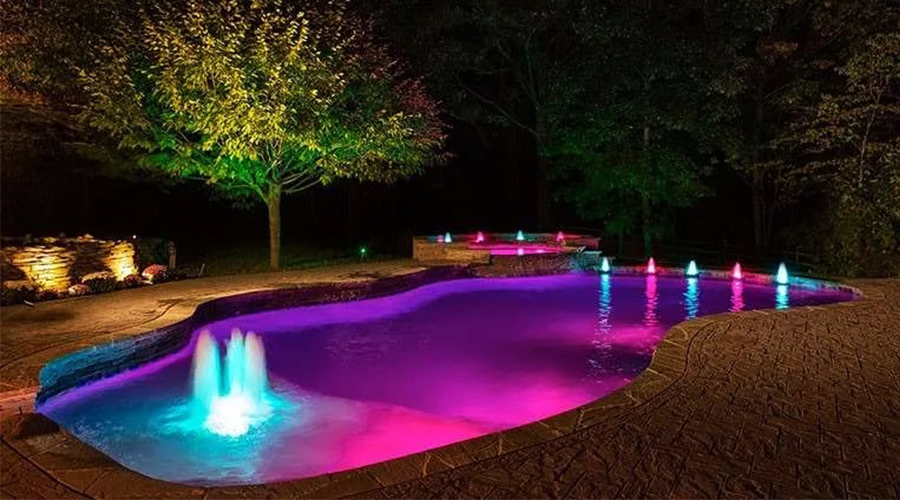
III. Installation and Construction “Five-Step Method” (SOP)
Following this process can avoid 90% of later malfunctions.
Step 1: Pre-installation and Positioning
- Height: Center of the light fixture 45cm – 60cm from the water surface.
- Too shallow: Glare, messy water surface.
- Too deep: Light is absorbed by the water, the pool bottom is dark, and maintenance requires draining the water.
- Spacing: Generally, install one underwater LED light every 3-5 meters (depending on wattage) to ensure no dark corners.
Step 2: Wiring and Conduit
- Use dedicated hydrolysis-resistant underwater cables (ordinary wires will crack after six months underwater).
- The pre-buried conduit should be slightly inclined towards the junction box to prevent water accumulation inside the conduit from flowing back into the LED pool lights.
Step 3: Joint Sealing (Crucial!)
- Strictly prohibit direct splicing of wires underwater or in damp pits.
- Correct Practice: Use an IP68 waterproof junction box, filled with waterproof sealant (epoxy resin), ensuring it hardens like stone and is waterproof after curing.
- Tip: Try to leave the joints in the inspection well on shore, not in the pool wall.
Step 4: Fixing and Grounding
- Tighten stainless steel screws diagonally, evenly, and flatten the sealing ring.
- A yellow-green dual-color grounding wire must be connected to the equipotential bonding terminal box.
Step 5: Testing and Acceptance
Before filling with water: Measure the insulation resistance (should be >0.5MΩ).
- After filling with water: Turn on the power and observe whether bubbles appear around the swimming pool lights (bubbles = leaks = substandard).

A successful swimming pool lights project = compliant 12V low-voltage system + true IP68 protection + scientifically designed light placement + strict waterproof connector technology.
Following these standards not only ensures the absolute safety of swimmers but also makes the pool a captivating visual focal point at night, while significantly reducing long-term maintenance costs.
Data & Standard Sources
1. [1] Internationally recognized basic standards (IEC – International Electrotechnical Commission)
This is the template for most countries worldwide (including China, the EU, Australia, Southeast Asia, etc.) to formulate their own national standards.
Installation Standard: IEC 60364-7-702 Full Name: Low-voltage electrical installations – Part 7-702: Requirements for special installations or locations – Swimming pools and fountains.
Core Content: Defines the zones 0, 1, and 2 for swimming pools, specifying the required voltage levels (e.g., Zone 0 must be ≤12V AC), protection rating (IPX8), and equipotential bonding requirements for each zone.
Source: International Electrotechnical Commission (IEC)
Lighting Product Standard: IEC 60598-2-18 (Latest version: 3rd edition, 2022)
Full Name: Luminaires – Part 2-18: Particular requirements – Luminaires for swimming pools and similar applications.
Core Content: Specific test methods for the structure, sealing, pressure resistance, corrosion resistance, and protection against electric shock of swimming pool lighting fixtures.
Source: IEC Webstore
2. North America (United States/Canada)
North America has an independent and extremely stringent standards system, primarily based on NEC.
Installation Specification: NFPA 70 (NEC) Article 680
Full Name: National Electrical Code® – Article 680: Swimming Pools, Fountains, and Similar Installations.
Core Content: Mandatory requirement that all underwater lighting fixtures be installed by authorized personnel, must use GFCI (Ground Current Compatibility), and strictly regulates junction box location, grounding wire size (typically 8 AWG copper wire), and transformer isolation requirements. This is the legal basis for enforcement in all 50 US states.
Source: National Fire Protection Association (NFPA)
Product Certification: UL 1081
Full Name: Standard for Safety for Underwater Luminaires and Submersible Junction Boxes.
Core Content: Underwriters Laboratories (UL)’s specific safety standard for underwater lighting fixtures; obtaining this certification is a prerequisite for entering the US market.
Source: UL Solutions
3. Europe (EU/UK)
European standards are usually directly translated from IEC standards, but with the EN prefix.
Installation Specification: HD 60364-7-702 (the European harmonized version of IEC 60364-7-702)
Source: CENELEC (European Committee for Electrotechnical Standardization)
Lighting Product Standard: EN IEC 60598-2-18
Note: EU CE certification requires testing according to this standard.
Protection Rating Definition: EN 60529 (i.e. IEC 60529)
Core Content: Defines the specific test conditions for IP codes (e.g., IP68).
4. Australia and New Zealand
Installation Specification: AS/NZS 3000:2018 (Wiring Rules) Section 7.4
Core Content: Specific electrical installation requirements for swimming pools and whirlpools, with extremely stringent requirements, emphasizing the use of RCDs (Residual Current Devices).
Source: Standards Australia
Lighting Fixture Product Standard: AS/NZS 60598.2.18
5. China
Chinese standards are mainly equivalent to IEC standards.
Installation Specification: GB/T 16895.19-2017
Correspondence: Fully equivalent to IEC 60364-7-702:2010.
Source: Standardization Administration of China
Lighting Fixture Product Standard: GB 7000.218-2008 (or later version)
Correspondence: Fully equivalent to IEC 60598-2-18.
Source: Standardization Administration of China