
Solar navigation lights can be used as bridge and culvert lighting because they can provide illumination without an external power source. They are therefore also called aviation obstruction lights.
Solar aviation obstruction lights use solar panels to generate electricity, store the energy, and then provide illumination through LED lights. Bridge and culvert lighting often requires illumination at night or in low-light conditions to ensure the safety of bridges and culverts.
The advantages of using solar aviation obstruction warning lights as bridge and culvert lighting are environmental friendliness, energy saving, simple installation, and reduced maintenance costs. They are particularly suitable for remote areas or where laying cables is difficult.
Solar Navigation Lights – Bridge & Culvert Lighting Applications
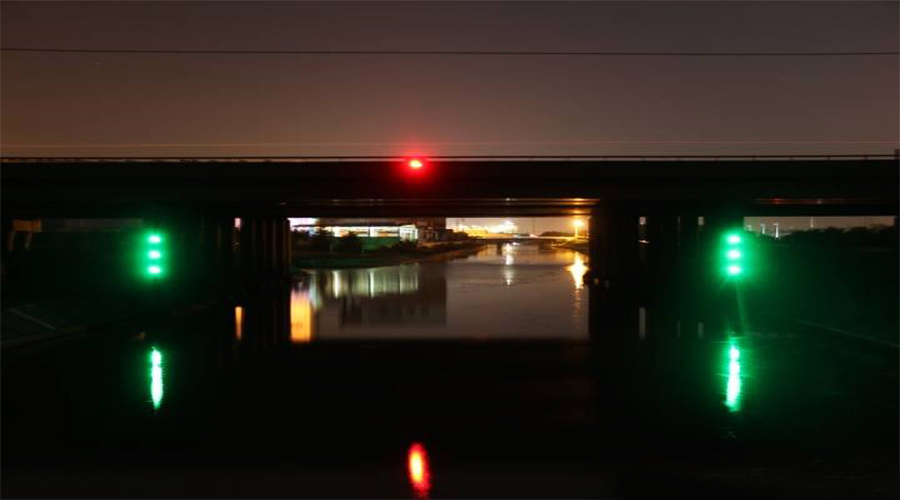
Bridge and culvert lights, bridge column lights, and clear height sign lights are primarily used on bridges, columns, and bridge openings on inland rivers, lakes, and seas.
They indicate the location of the bridge’s navigation opening, guiding ships through it safely, and acting as a collision avoidance system for bridge piers, thereby ensuring the safe operation of the bridge and indicating a safe and economical navigation route for ships.
Bridge and culvert aircraft warning lights are typically installed on the center of the half-span navigation opening, one on each side, upstream and downstream.
Each bridge culvert warning light must comply with the requirements of “Navigation Light Signal Colors” (GB12708-1991) and “Navigation Light Intensity Measurement and Light Range Calculation” (JT/T730-2008). Each bridge culvert warning light is powered by a separate set of solar panels or an AC 220V line.
Culvert lights are generally used in conjunction with bridge column lights.
The bridge column lights are installed on the bridge columns on both sides of the main span, with four lights installed upstream and downstream of each column, for a total of 16.
The bridge column lights comply with the requirements of “Navigation Light Signal Colors” (GB12708-1991) and “Navigation Light Intensity Measurement and Light Range Calculation” (JT/T730-2008). Each column light is powered by a separate solar panel or AC 220V line.
Benefits of Installing Solar Navigation Lights
Saves Power Costs
Solar warning lights have their own photovoltaic power generation and energy storage systems, reducing reliance on the municipal power grid and significantly lowering long-term operation and maintenance costs. Flexible installation and adaptability.
No high-voltage cables are required, making them suitable for difficult-to-wire locations like bridges and culverts. This reduces installation costs and minimizes construction disruption.
Emergency & high reliability.
The energy storage system provides power at night or on rainy days, allowing the solar lights to operate continuously, improving waterway availability and safety.
Featuring intelligent controls such as low power consumption and automatic on/off, they provide self-protection and issue warning signals in the event of a fault.
Easy maintenance & long life.
Modern solar-powered aviation obstacle lights typically feature corrosion-resistant and waterproof designs, resulting in long maintenance cycles and relatively low maintenance workload.
Integrated self-diagnosis and remote monitoring (if equipped with communication capabilities) facilitate remote diagnosis by operators.
Environmental protection & sustainability.
No pollutants are emitted, aligning with the principles of green ports and green waterways.
Coastal or riverine areas with abundant solar resources are particularly advantageous, with minimal long-term environmental impact.
Improving safety & port image.
The stable illumination of solar-powered bridge and culvert lights improves waterway visibility, reduces collision risks, and contributes to enhanced navigation safety. Suitable for complex environments and high-frequency use scenarios
The complex environment beneath bridges and culverts or around piers makes wiring difficult. Solar systems provide reliable lighting and guidance, especially in tidal and high-current waters.
If you have any questions or needs regarding solar-powered aviation obstruction warning lights, please feel free to contact us.