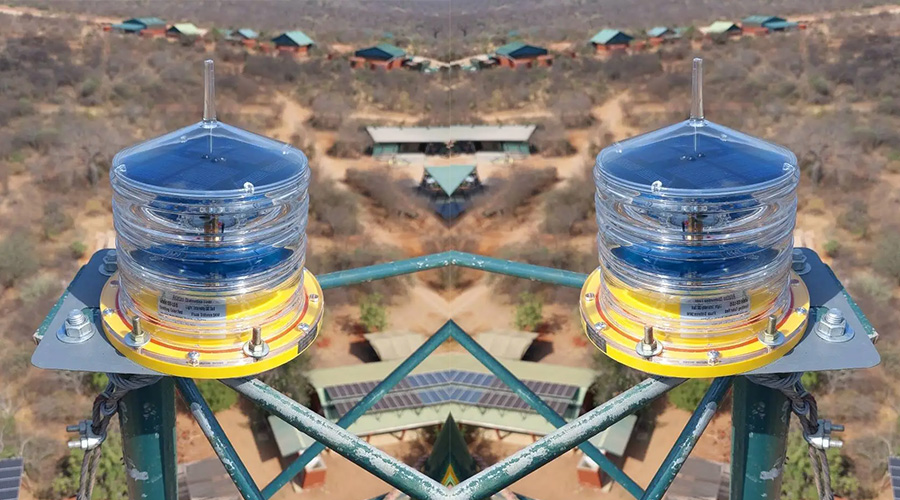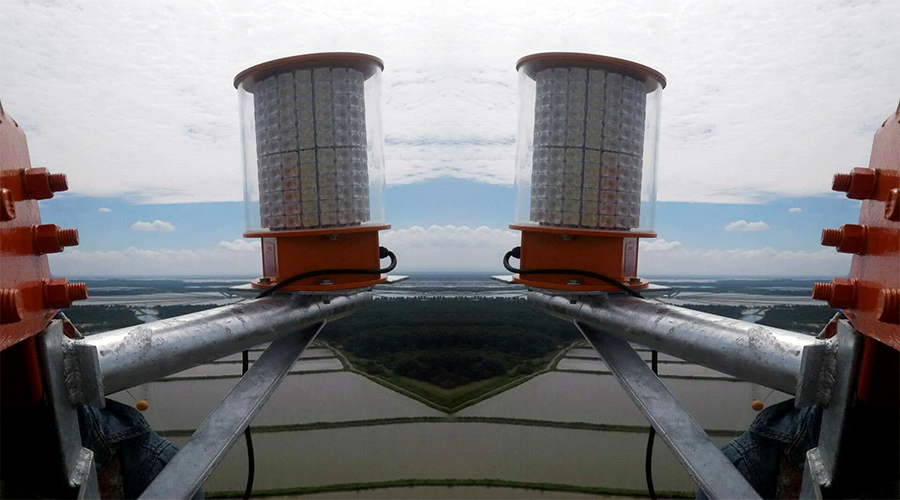


Solar marine lights (typically referring to solar-powered navigation lights used as beacons, buoys, or maritime warning lights) rely heavily on GPS synchronization, a key technology primarily used to address the issue of consistent flashing when multiple lights are operating in tandem.
By providing a unified “time reference” for dispersed navigational aids, it transforms chaotic light signals into a clear and orderly visual language, significantly improving navigation efficiency and safety.
Solar Marine Lights With GPS Synchronization Function
1. Function
Without GPS synchronization, multiple independent solar-powered navigation lights, even when set to the same flashing frequency (e.g., 30 flashes per minute), will gradually drift apart due to minute errors in their internal crystal oscillators and differences in start-up time, resulting in a chaotic appearance.
The GPS synchronization function allows dozens or even hundreds of lights distributed across a vast sea area to simultaneously illuminate and extinguish, and even flash in the same pattern, within the same millisecond.
- Visual Effect: Forming a uniform “wall of light” or a specific synchronized flashing pattern greatly enhances the visibility of warnings.
- Identification: Helps navigators quickly identify specific waterways, warning zones, or large facilities (such as offshore wind farms and drilling platforms) through specific synchronized flashing patterns (e.g., group flashes, tandem flashes).
- Effectiveness: Custom-designed lights with 350 flashing codes; GPS synchronization allows remote control adjustment of all marine lights within range to the same flashing pattern.

2. Working Principle:
The solar marine warning light relies on a built-in high-sensitivity GPS receiver module:
- 1) Signal Reception:
The GPS module within the navigation light receives satellite signals in real time.
- 2) PPS Pulse Calibration:
GPS satellites send a high-precision pulse-per-second (PPS) signal every second. This signal has extremely high accuracy (typically at the microsecond level).
- 3) Internal Alignment:
The solar-powered light’s control circuit uses this PPS signal as a time reference to forcibly reset the internal flashing timer.
- 4) Synchronized Execution:
Regardless of the marine light’s previous state, once it receives the PPS signal, all lights within range with this function enabled will uniformly execute the flashing action at the next full second.
For example, the YFFY-LS-E solar marine lights can synchronize with all marine navigation lights within a 100-meter range via GPS.
3. Application Scenarios
- Offshore Wind Farms:
This is currently the largest application market. To warn vessels to avoid massive wind turbine arrays, a ring of solar navigation lights is deployed around them.
If not synchronized, the lights will flash intermittently, easily causing visual fatigue or misjudgment for crew members; synchronized flashing clearly delineates the boundaries of the wind farm.
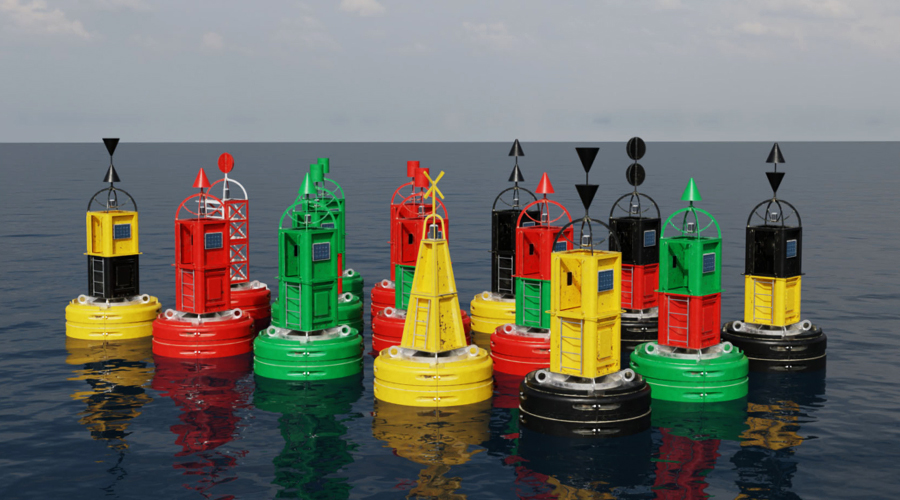
- Buoys/Navigation:
Multiple navigation aids flash synchronously via GPS, forming a conspicuous “electronic fence” to clearly mark no-navigation zones or aquaculture areas. This clearly defines the water area.
- Large Bridge Collision Prevention:
Solar-powered warning lights on bridge piers need to flash synchronously to indicate the width of the bridge arches.
- Navigation Aids:
Outlining waterways and eliminating visual confusion. Synchronized solar-powered LED lights on both sides of the waterway form two clear and continuous “light bands” at night to guide direction;
synchronized warning lights on cross-sea bridges or wind farms completely outline the facilities, preventing collisions.
- Port Channels and Breakwaters:
Rows of marine lights installed along long breakwaters flash synchronously to create clear guide lines.
- Oil Drilling Platforms:
LED warning lights around the platform flash synchronously, enhancing nighttime visibility.
4. Technological Advantages
- No Wiring Required:
Traditional synchronization may require cables connecting master and slave lights, while GPS synchronization is wireless. Each marine navigation warning light operates independently but with a consistent rhythm, ideal for dispersed deployments at sea.
- High Precision:
Synchronization errors are typically less than 10 milliseconds, an imperceptible delay to the human eye, considered absolute synchronization.
- Interference Resistance:
Even with a brief loss of GPS signal (e.g., obstruction), a high-quality controller can maintain synchronization for a period using its internal high-stability crystal oscillator, automatically recalibrating once the signal is restored.
- Energy Saving:
Some customized solar marine lights (e.g., the YFFY-LS-S solar warning light) intelligent systems can use GPS positioning to determine day/night and location, automatically adjusting brightness or operating mode to save solar power.
5. Common Flashing Patterns
Solar-powered navigation lights used for maritime warnings can achieve complex coded flashing through GPS synchronization, such as:
- Iso (Equal Brightness/Darkness): Lights flash synchronously with equal on/off times.
- Group Flashing: For example, “two flashes,” all lights flash twice simultaneously, pause, and then flash twice again simultaneously.
- Morse Code: Although less commonly used for general navigation lights, it can synchronously send light signals of specific letters in specific markings.
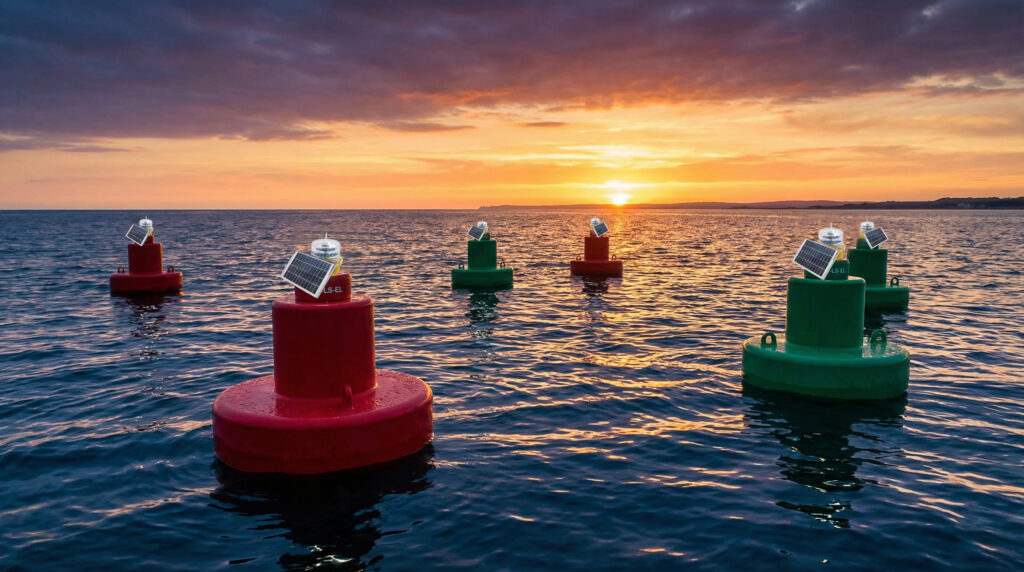
The GPS synchronization function of solar marine lights embodies the intelligence of modern navigational aids. It transforms previously independent lights into a coordinated, distributed lighting system.
Whether for defining areas, guiding navigation channels, or ensuring data consistency, it greatly reduces the cognitive load on operators, significantly improves the safety and navigation efficiency of maritime operations, and is indispensable, especially in large-scale cluster applications such as offshore wind power.