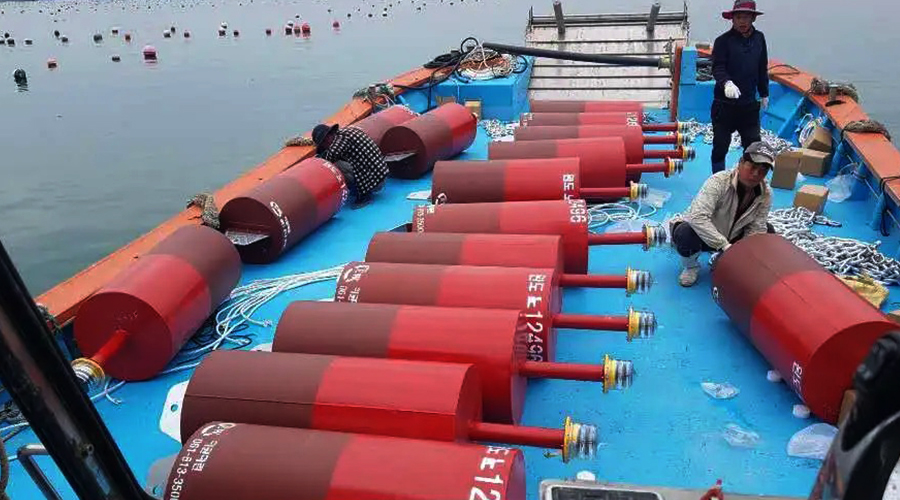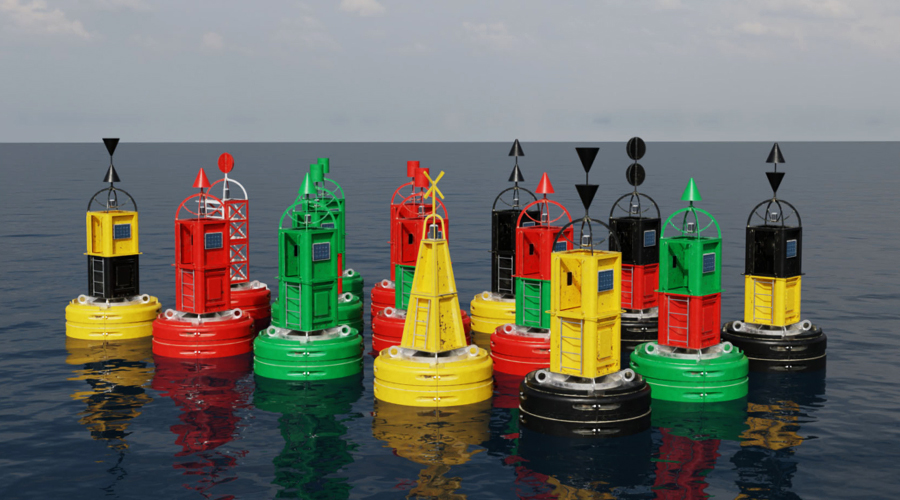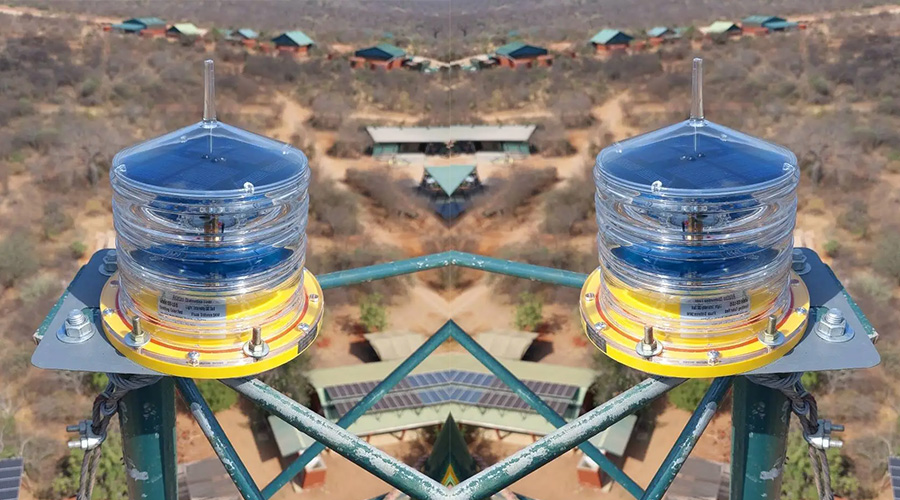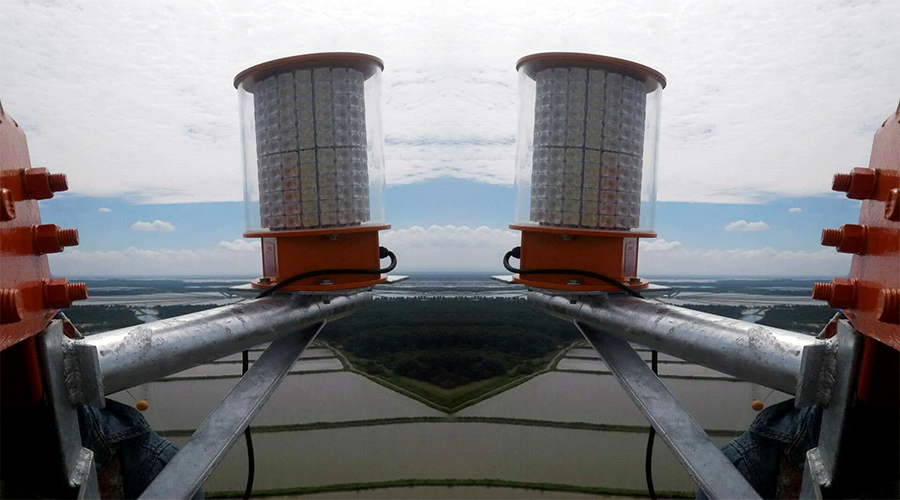
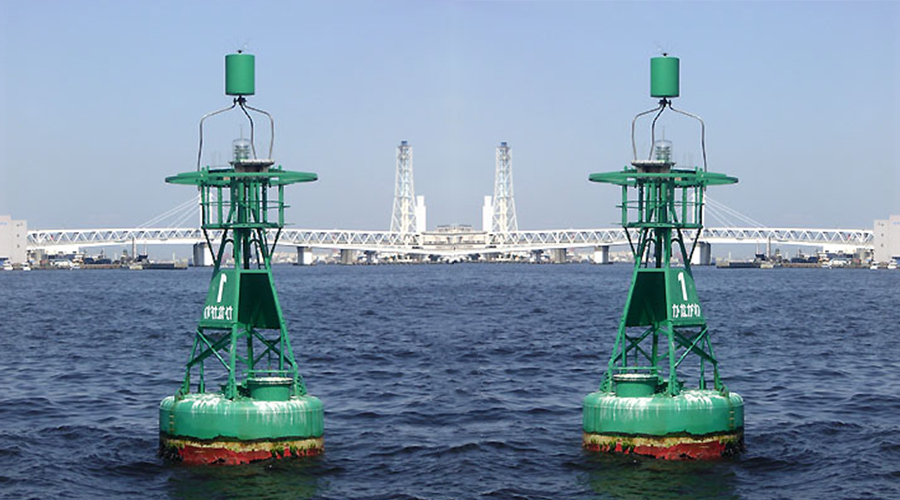

Solar lights for navigation aids: As the name suggests, are primarily installed on buoys, offshore floats, and other navigational aids. Their visibility distance requirements depend on the specific application scenario and relevant standards. At night, the light’s visibility distance must meet the maximum distance at which an observer can clearly discern it.
Solar Lights For Navigation Aids – Visibility Requirements
1) General Principles
- Visibility distance (V): refers to the distance at which a solar-powered marine navigation light can be clearly discerned by a vessel’s pilot at night or in low-visibility conditions, typically expressed in nautical miles (NM).
- Influencing factors include the power and height of the solar marine lights, mounting altitude, ambient light and sea surface reflection, weather conditions, ambient light pollution, background contrast, and the color and flash pattern of the light.
2) Visibility distance of navigational aids (buoys, shore markers, lighthouses, etc.)
- Nighttime visibility distance (V): The nighttime visibility distance must meet the requirement that, at the specified vessel speed, the crew can react quickly when the light is visible and the color is clearly discernible.
- Color & Flash Characteristics: Clearly distinguishable from ground-based lights, typically using colors and flashing patterns that comply with international/regional standards.
- Typical ranges vary depending on region, solar light model, and environment; the following is a reference range:
- Common shallow channel/port navigational aids: 2–10 nm and above, depending on the light’s height, light intensity, and environmental conditions.
- Higher altitude, higher-intensity lights: 10–20 nm solar lights for navigation aids, or even further.
- Design Key: Select appropriate marine navigational lights to cover the actual channel length and vessel size.
3) Special Case of Solar Lights For Navigation Aids
- Solar marine warning lights must consider sunlight duration, battery capacity, nighttime endurance, and visibility stability during the design phase.
- Typical model examples include the YFFY-LS-C-1 solar lights for navigation aids, which has a nighttime visibility of 4 nm and above, and color must comply with IALA requirements.
- Actual visibility is still affected by installation height, environmental conditions, and other factors. Manufacturer specifications and regional standards should be used as the basis.
4) Key Conditions Affecting Visibility
- Atmospheric & Environmental Factors: Fog, rain, haze, and storms can significantly reduce visibility.
- Sea Surface Reflections and Light Pollution: Background light from shore lights and ship lights can reduce contrast and shorten effective visibility.
- Background Contrast: The higher the contrast between the navigation light’s color and the background sea and sky, the longer the identification distance.
5) Practical Key Points for Selection & Design
- Environmental Matching: When sea conditions are good and short-range identification is required, choose a solar navigation light with a relatively low visibility rating. When long-range identification is required, choose a solution with high brightness and a higher mounting height solar warning lights.
- Day/Night Continuity & Energy Efficiency: Solar lights must consider sunlight duration and battery capacity to ensure nighttime visibility is within the designed range.
- Maintenance & Lifespan: Higher brightness often comes with higher power consumption, requiring a trade-off between battery life, charge/discharge cycles, and maintenance frequency.
Application Cases of Solar Marine Warning Lights
Solar navigation warning lights for marine use are available with visibility ranges from 1 to 20 nm. You can select the appropriate solar buoy lights, solar boat lights and solar marine lantern for installation and use based on your requirements.