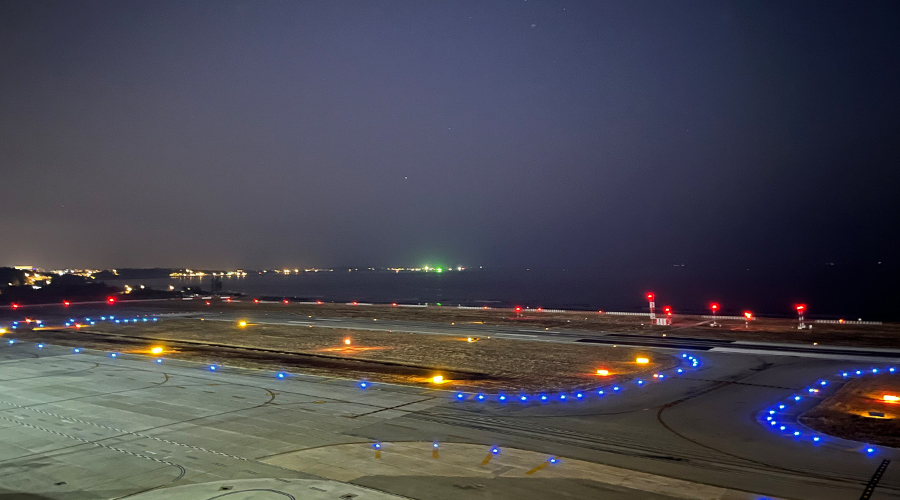

Airport taxiway lights are important airport lighting that guide aircraft taxiing on the airport ground. They are mainly installed on both sides of the taxiway between the apron and the runway.
After landing, the aircraft will enter the taxiway through the green exit light. The height of the vertical lamps installed on the pavement is strictly limited to ensure safety.
The setting and color coding of these airport lights help pilots to taxi and guide aircraft safely at night or in bad weather conditions.
Requirements For Airport Taxiway Lights
Taxiway lights include taxiway edge lights, taxiway centerline lights, stop bar lights, intermediate waiting position lights, runway guard lights, etc. Each lamp has its specific color, light intensity and installation location requirements to ensure that pilots can clearly identify the taxiway in different weather conditions and taxi safely.
Edge lights:
Usually blue, installed on the edges of both sides of the taxiway to indicate the edge position of the taxiway.
Centerline lights:
Usually green, set on the centerline of the taxiway to provide pilots with continuous taxiing guidance, especially in low visibility conditions.
Stop bar lights:
Red one-way lights, installed on taxiways, used to indicate the parking position of aircraft, controlled by air traffic control (ATC), red lights indicate that passage is prohibited.
Intermediate waiting position lights:
Steady yellow lights, installed on taxiways, used to guide aircraft to wait before the runway entrance.
Runway warning lights:
Warning lights, used to warn pilots that they are about to enter the runway.
Installation & Light Intensity of Airport Lights
Installation
- Airport taxiway edge lights should be installed on the edges of both sides of the taxiway, and the spacing should be evenly distributed.
- Taxiway centerline lights should be installed on the centerline of the taxiway, and the spacing is generally less than 60 meters.
- Stop bar lights should be installed on the taxiway, across the taxiway, with a spacing of 3 meters.
Light intensity
- The light intensity of taxiway edge lights should be at least 2cd in the vertical 0°~6° (1°~6° for embedded) elevation range at all horizontal azimuths, and at least 0.2cd in the 6°~75° elevation range.
- The light intensity of the lamps should meet the visibility requirements under various weather conditions and should be strong enough to be clearly visible even when the surrounding lights are dim.
Other requirements
- Taxiway lights should have good weather resistance and impact resistance and be able to work normally under various environmental conditions.
- The maintenance and replacement of the airfield ground lighting system should be convenient and fast to ensure the normal operation of the airport.
In short, the design and installation of airport taxiway lights should fully consider flight safety and ensure that the lights can clearly and accurately guide the aircraft to operate safely on the taxiway.
( The above content refers to the “Technical Requirements for Runway and Taxiway Navigation Lights” )