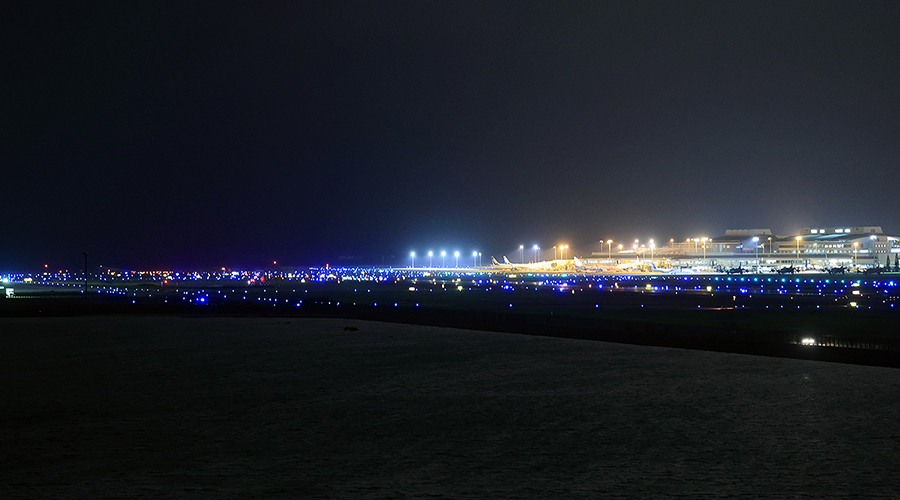

Taxiway edge lights are a crucial component of an airport’s navigational lighting system, primarily used to provide visual guidance to pilots at taxiway edges at night or in low-visibility conditions. They are evenly spaced along both sides of the taxiway, emitting a constant blue light, forming a strip of light to help pilots identify the taxiway edge.
These airport lights are typically located along the edges of the taxiway or within 3 meters of the edge.
Airport taxiway edge lights typically emit a blue light to help pilots clearly identify the taxiway at night or in poor weather conditions. They are crucial for ensuring safe taxiing at the airport.
Airport Edge Light Characteristics
- Color: They emit a constant blue light.
- Location: They are located along both sides of the taxiway or within 3 meters of the edge.
- Spacing: On both straight and curved sections, edge lights should be spaced no more than 60 meters apart longitudinally.
- Purpose: Airport warning lights provide visual guidance, helping pilots taxi safely at night or in low-visibility conditions.
Taxiway Edge Lights Installation Standards
Airport Led lights are specified by standards/recommendations issued by national civil aviation authorities or the International Civil Aviation Organization (ICAO) and may vary slightly depending on the airport grade, taxiway type, and environmental conditions.
Location & Spacing
Lights are evenly spaced along both sides of the taxiway edge, typically aligned with or slightly offset to the taxiway edge, and typically no more than 3 meters from the edge. Typical nominal spacing is 50–60 meters (depending on light type, visibility requirements, and taxiway width), with closer spacing possible at curves, intersections, or areas with restricted visibility.
Light Type & Height
Common light types include omnidirectional vertical lights (such as LEDs) and recessed lights.
Light height must be coordinated with taxiway clearance, pilot visibility, and surrounding obstacle heights. Lights are typically positioned above the ground to ensure coverage of the edge area without causing glare to aircraft.
Light Color & Intensity
Taxiway edge lights typically emit a blue light to facilitate identification of taxiway boundaries at night. Brightness levels must meet visibility requirements, ensuring clear boundary identification even in low-visibility conditions. Dimmable or graded brightness levels are typically used to adapt to different weather conditions and time of day.
Foundation & Protection
The lamp base must be earthquake- and wind-resistant, capable of withstanding the loads and vibrations of the airport environment.
The required level of protection is typically high, suitable for exposure to open air, rain, snow, salt spray, and other environments. Common ratings include IP65 and above, but the specific requirements are subject to design standards.
Power Supply & Control
The power supply typically has an independent circuit with redundancy, power failure protection, and fault alarm functions.
Taxiway edge lights are often connected to the airport’s centralized lighting control system, which provides day/night switching, energy consumption management, and fault diagnosis capabilities.
Maintenance & Inspection
Airport lighting should have a maintenance cycle that includes regular cleaning, brightness and color temperature inspections, light source life assessments, and coordinate positioning.
Optical performance testing, alignment, and calibration should be performed annually or during the service life to ensure that spacing and alignment remain within specifications.
Safety & Accessibility
Airport edge lights should be easily accessible to maintenance personnel, but the protective design should ensure safety during maintenance. This prevents airfield ground lighting systems from obstructing ground access routes, and the lamp surface is non-slip and easy to clean.
If you have any questions, please feel free to contact us.