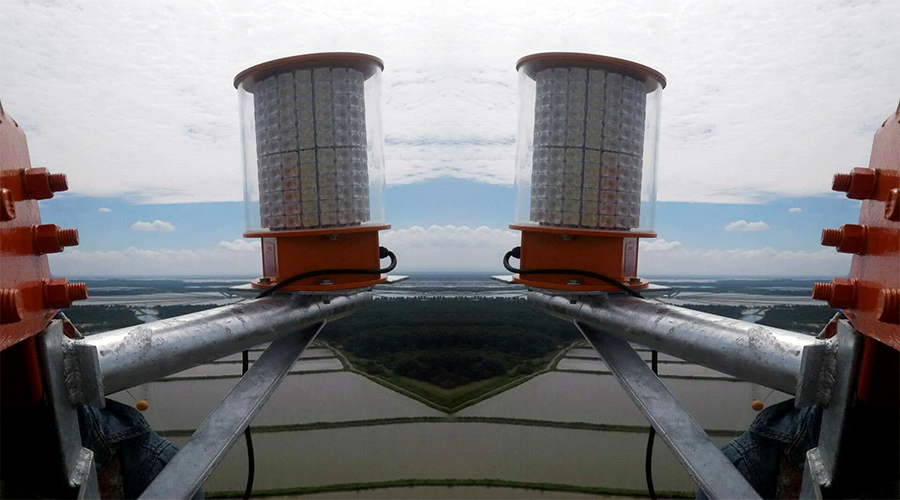
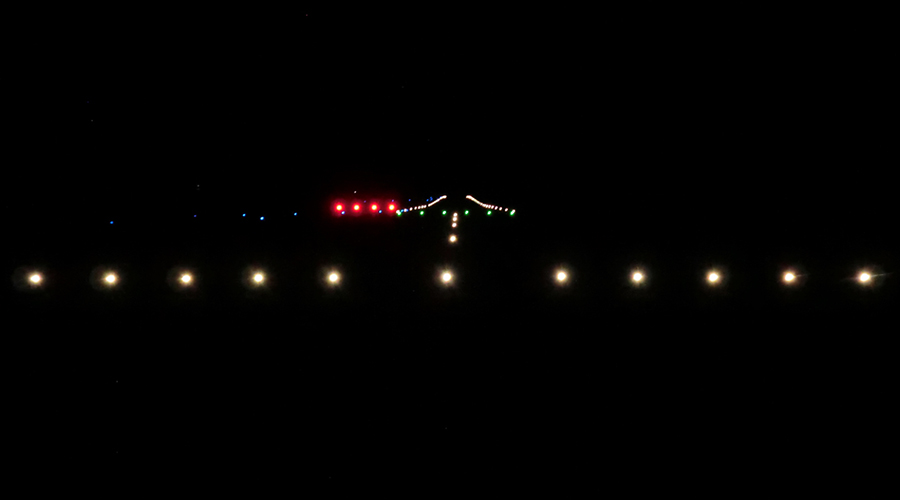

PAPI lights (Precision Approach Path Indicator) are visual aids used to guide pilots on the correct glide path. They consist of four high-intensity bulbs and are typically located on the left side of the runway near the touchdown zone.
Main Function of PAPI Light
- PAPI runway lights provide pilots with a direct visual indication of their position relative to the optimal glide slope (typically 3 degrees).
- They help pilots maintain a stable glide path angle during landing, ensuring a safe approach.
- Compared to other visual glide path indicators, the PAPI system consists of four separate lights, providing more detailed approach altitude information.
- PAPI airport lights are typically installed on the side of the runway approximately 300 meters beyond the landing end.
How to Use the Airport PAPI Lights?
Assume the runway is at an elevation of 0 feet relative to sea level.
Then, proceed 3 nautical miles back along the runway to the final approach fix.
One nautical mile is approximately 6,076 feet (1.852 kilometers), and 3 nautical miles is 18,228 feet.
Using this as an example, we can use the tangent function in trigonometry to calculate the correct aircraft altitude. This is shown in the figure below:
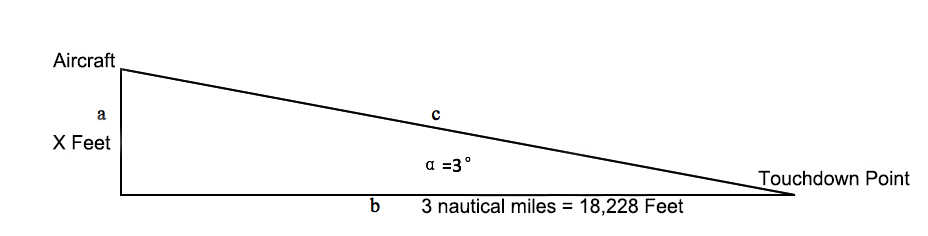
Side a of the triangle represents the aircraft’s current altitude, and side b represents the horizontal distance from the aircraft’s current position to the touchdown point on the runway.
The PAPI light’s inclination angle is α = 3°, and b = 18228 feet. Therefore, we can easily calculate the aircraft’s current altitude as a = b * tan(3°) = 18228 * 0.0524 = 955. This means the aircraft’s current altitude should be 955 feet, which is usually rounded to 1000 feet.
Thus, when you are 3 nautical miles from the touchdown zone, your altitude should be around 1000 feet, and the PAPI lights you see at this point will be in the correct arrangement. Without the assistance of a precision navigation system, the PAPI lights provide an accurate, reliable, and unique indicator of glide path height.
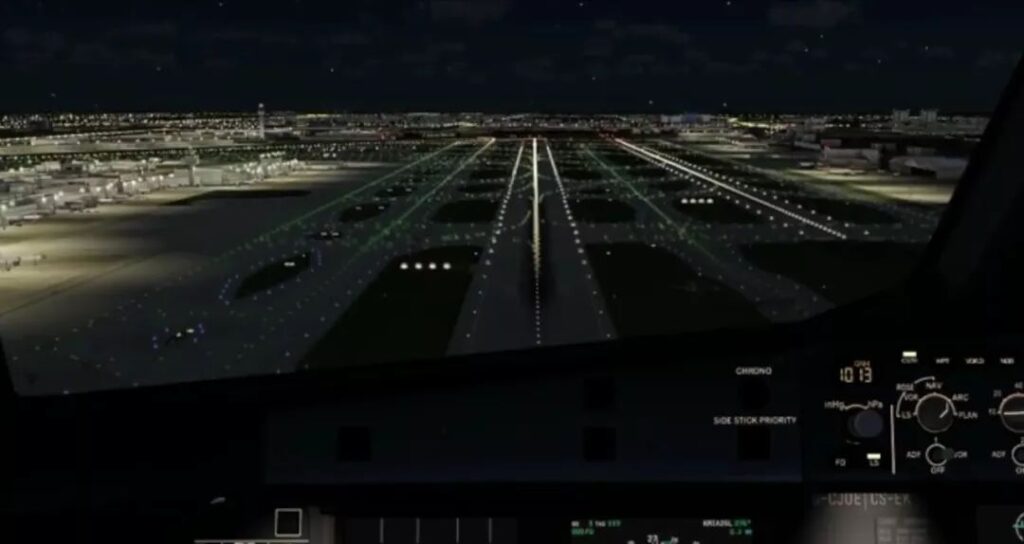
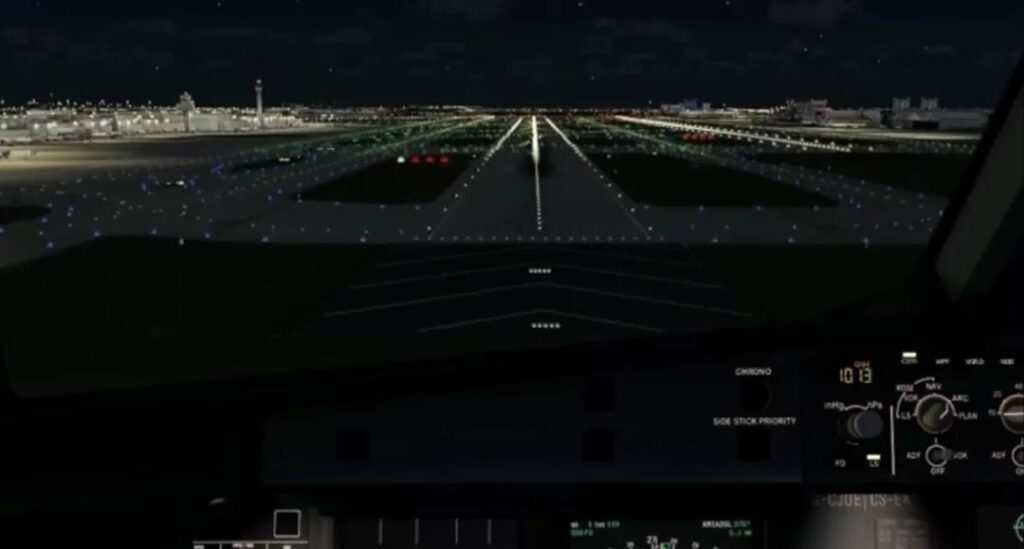
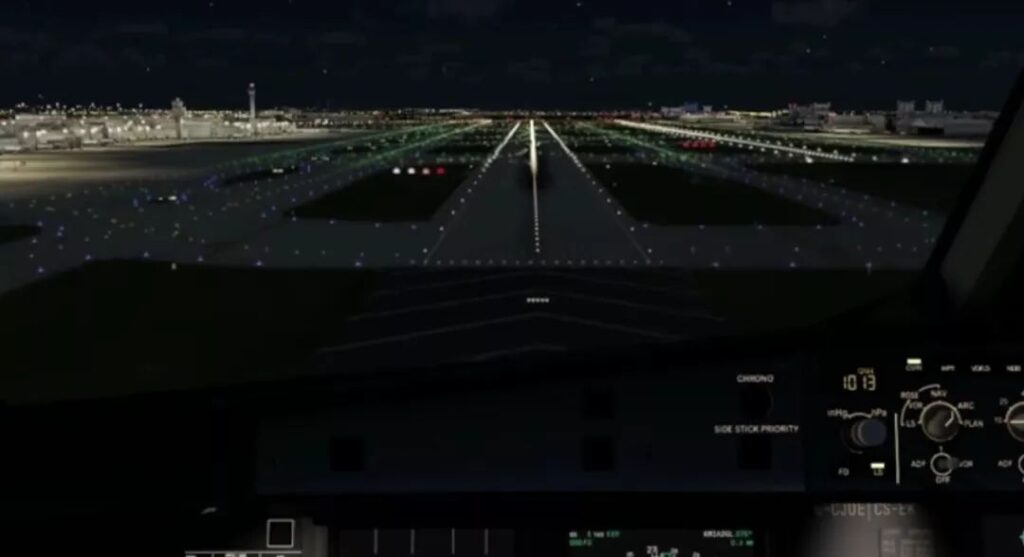
In the following image, we can see that the PAPI lights on the left side of the runway are showing four white lights. This clearly indicates that the aircraft is too high. The pilot needs to increase the pitch angle to increase the descent rate and slightly reduce the throttle to return the aircraft to the correct glide path.
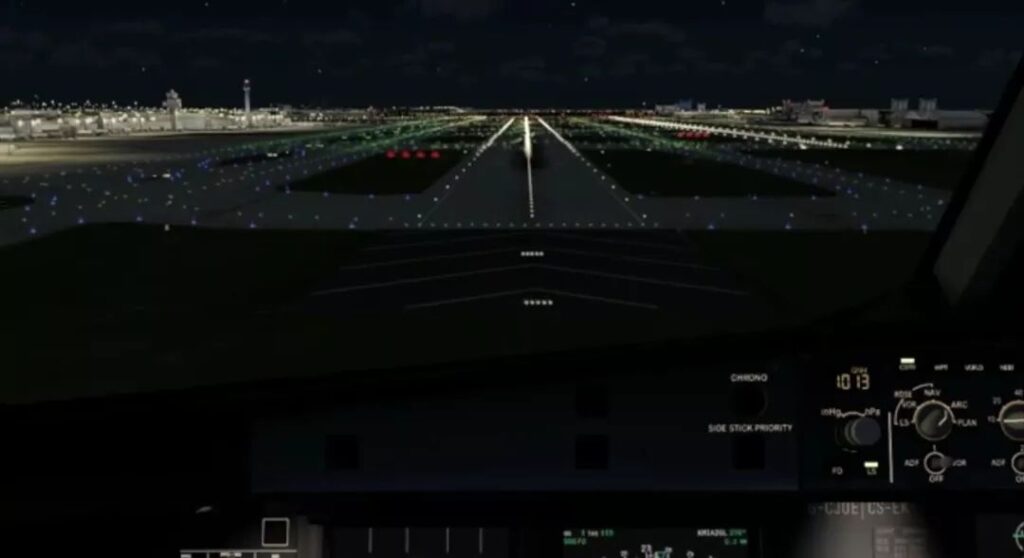
If the aircraft’s pitch angle is too large or the throttle is increased, you will see four red lights, indicating that your aircraft is below the standard glide path. You need to increase the throttle and move the joystick slightly back to increase the pitch angle to reduce the descent rate.
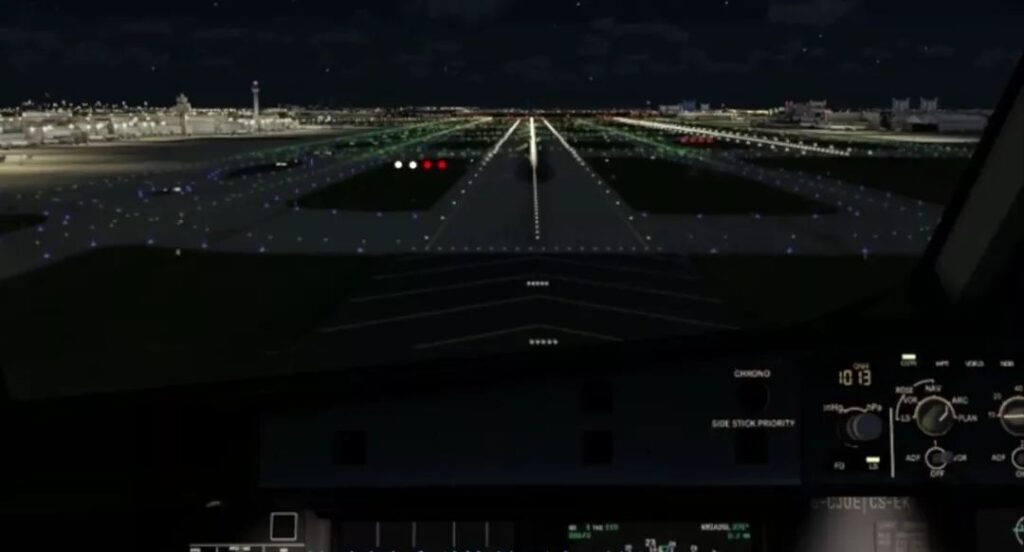
So what does the PAPI light indicate when the aircraft is on the correct glide path? When you see two red and two white lights, it means the aircraft is on the correct glide path. All you need to do is maintain the current aircraft attitude and throttle and continue the approach.
Of course, since there are four lights, there are two situations: “three white and one red” or “three red and one white”. Obviously, more red lights mean low, and more white lights mean high. It can prompt the pilot to judge and correct the height of the glide path in time.
The above explains the working principles and uses of PAPI lights in airfield ground lighting systems (AGL). To summarize, it can be summed up in one sentence:
” White on white, check your height; Red on white, we are alright; Red on red, into the bushes. “
If you have any questions or needs regarding taxiway lights, runway lights, edge lights, helipad lights, and other airport lighting, please feel free to contact us to provide you with better service and products.