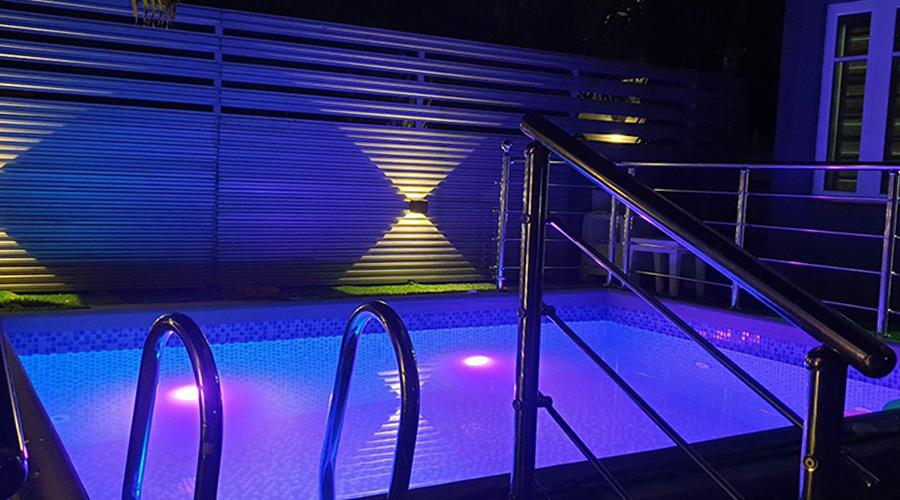

About swimming pool lights: According to the requirements of the management system, each swimming pool needs to have swimming pool underwater lights to ensure swimming pool lighting.
In addition to swimming pools, underwater pool light also used for underwater lighting such as hot springs, fountains, landscape pools, and massage pools. It can be used for swimming pool bottom lighting, and it can also allow swimmers to see the bottom of the pool clearly, adding icing on the cake to the swimming pool, making the swimming pool at night more colorful and beautiful. It can be said to be the best of both worlds.
Features of Swimming Pool Underwater Lights
In recent years, swimming pool lights have been optimized and designed. The lamp body uses a new anti-corrosion material and a transparent cover with extremely high light transmittance. The appearance is small and exquisite, and the chassis is fixed with screws.
Underwater pool lights are generally LED light sources. LED is called the fourth generation lighting source or green light source. It has the characteristics of energy saving, environmental protection, small size, and long life.
How To Choose Swimming Pool Lights Correctly
The first consideration in choosing swimming pool underwater light is safety. Some regulations are as follows:
1. Dustproof & waterproof grade identification.
The dustproof grade of underwater lighting is divided into 6 levels. Among them, the 6th level is high. The waterproof level of lamps is divided into 8 levels, of which the 6th level is advanced. The dustproof level of underwater colored lights should reach 6 levels, and its marking symbol is: IP61–IP68.
2. Anti-electric shock index.
The anti-electric shock index of LED underwater lights is divided into four categories: Class O, Class I, Class II, and Class III.
The national standard clearly stipulates that for underwater lighting fixtures in similar places such as swimming pools, fountains, and paddling pools, the anti-electric shock protection should be Class III LED lamps. The working voltage of its external and internal circuits should not exceed 12V.
3. Rated working voltage.
The installation of swimming pool lamps must be strictly controlled below the human safety voltage of 36V (a special transformer is required). Swimming pool underwater lights are installed underwater in the swimming pool for lighting.
Not only waterproof, but also anti-electric shock. Therefore, its rated working voltage is generally very low, usually 12V.
The rated working voltage of underwater LED lights is a parameter indicator of the lamp, which directly determines the use environment of the lamp, that is, the actual working voltage must be consistent with the rated working voltage.
Otherwise, the light source will be burned out due to excessive voltage, or the lighting effect will not be achieved due to too low voltage. Therefore, general underwater lights need to be used together with transformers. The transformer provides stable voltage, so that the swimming pool underwater lamp can work safely and stably.
And YFFY’s LED underwater pool lights are not only waterproof, low voltage, with stable performance, safe and reliable, but also have a unique design of multi-functional, colorful and bright. In addition to meeting the lighting function of the swimming pool, it also provides unlimited possibilities for the swimming pool to be colorful and gorgeous. Its undoubtedly the ideal choice for swimming pool owners and operators!
Recommended Products
YFFY 9W LED Underwater Swimming Pool Lights YFFY-PLRB01009
- High efficiency, energy saving, environmental protection, low power consumption, compared with ordinary underwater lights on the market, it saves 80% energy;
- High-quality material shell, stable performance, safe operation, long service life;
- There is also a WIFI light group controller suitable for iOS and Android systems;
- The RGB underwater light synchronization mode can be customized, and the same group of lights can be remotely controlled to change color synchronously. It has complete functions and can be widely used in swimming pools, hot springs, water parks, fountain pools and other engineering projects to improve your design.